

Last Updated: October 2026
At a Glance: DIY Wind Turbine Ideas
- Cost: A DIY wind turbine can cost next to nothing for a bottle or carton model, up to a rough $200 to $500 for the high-output build.
- Time: An afternoon for the small experiments. The alternator build takes about a day, and the larger towers take longer.
- Space: Vertical-axis designs fit tight spots. Bladed turbines need a tall tower clear of trees and buildings.
- Skill level: Easy to hard. Each build below has its own difficulty rating.
RELATED: 15 Incredible Self-Sustaining Homes For Your Homesteading Passion
Is Wind Power Right for Your Site?
- Wind speed: Is your area consistently breezy? A common rule of thumb is an average of at least 10 mph.
- Zoning: Have you checked for height restrictions on towers?
- Energy need: Are you after a small 24W experiment or a build rated for 3,000 watts?
Answer these before you pick a design. If you checked all three, pay close attention to #9 and #11 below.
DIY Wind Turbine Ideas for Free and Green Energy Source
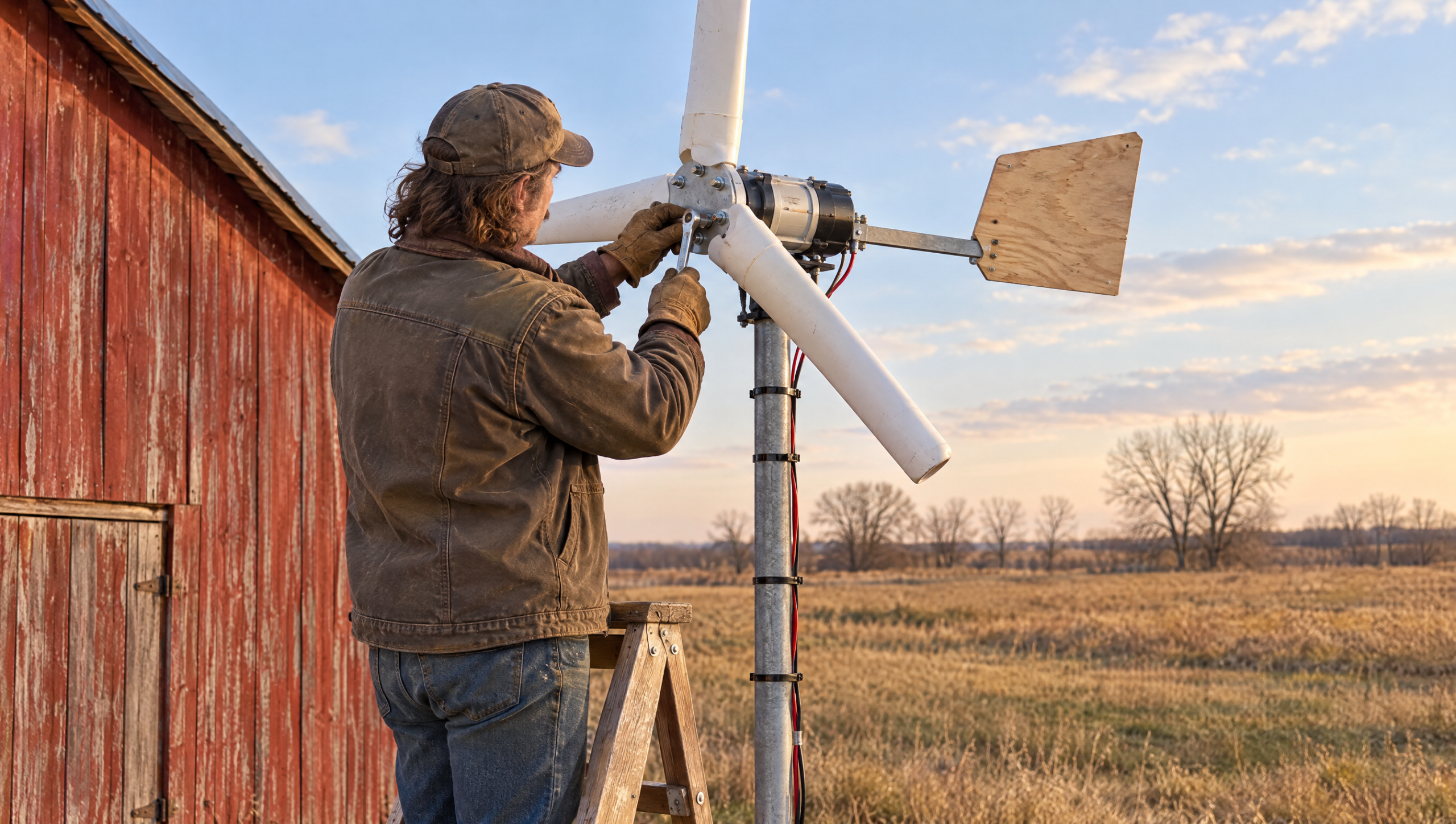
For homesteaders and off-grid enthusiasts, producing your own electricity is a major step toward true self-reliance. While solar power gets most of the attention, DIY wind turbine generators can be a powerful and cost-effective option in areas with consistent wind. When built and installed correctly, small wind turbines can supplement or even rival other renewable energy systems.
This guide explores how DIY wind turbines work, what you need to build one, and whether wind power makes sense for your off-grid setup. If you’re looking to reduce dependence on the grid and harness natural energy, wind may be part of the solution.
As an Amazon Associate, we earn from qualifying purchases.
1. $30 DIY Wind Turbine
A homesteader who never throws reusable stuff away sure can build this cost-effective DIY wind turbine. If you’re the crafty kind, you can do this for $30 and even less. Try it at a minimal cost.
| Build Overview: $30 Budget Turbine | Rough estimate |
|---|---|
| Difficulty | Easy |
| Est. cost | $30 or Less |
| Potential output | 24W to 50W |
Required materials:
- Rare Earth Magnets: Strong neodymium discs.
- Small DC Motor: Repurposed as a generator.
- PVC Pipes: For lightweight blade construction.
2. DIY Tesla Turbine
This good old machine (and by old, I mean a good hundred years old) has been a reliable industrial machine. It could definitely be so for your humble homestead, too.
By following this incredible tutorial and with the help of the right tools and types of equipment, you can have a Tesla turbine working in your homestead. Your basic know-how of this rotor is something your homestead could use.
Heads up: a Tesla turbine is built to spin on a jet of air, steam or water rather than open wind. Treat it as a hands-on lesson in bladeless rotors.
| Build Specs: Tesla Industrial Turbine | Rough estimate |
|---|---|
| Difficulty | Hard |
| Est. cost | $50 to $100 |
| Potential output | Not wind-driven as built |
Required materials:
- Smooth Metal Discs: For the century-old rotor design.
- Turbine Housing: Precision casing for high-speed operation.
- Precision Bearings: Essential for industrial-grade rotation.
3. DIY Miniature Wind Turbine
A large-scale turbine will seem imposing, but try this simple project to convince yourself otherwise. I’m pretty sure you’ll find this project engaging; it’s a worthwhile project that works well.
| Build Specs: Miniature Experiment | Rough estimate |
|---|---|
| Difficulty | Easy |
| Est. cost | Under $20 |
| Potential output | Educational Output |
Required materials:
- Small Hobby Motor: Standard toy-grade generator motor.
- Propeller Blades: Lightweight plastic or wooden hobby blades.
- LED Bulb: For testing and confirming power generation.
4. Repurposed Bike Parts DIY Wind-Power Water Pump
A simple homestead task such as emptying water out of a pond can use up quite a considerable amount of energy. This simple wind-powered pump could be the solution.
Reduce, reuse, and recycle in style, and generate energy to create a wind-powered water pump.
| Build Specs: Bike Part Water Pump | Rough estimate |
|---|---|
| Difficulty | Medium |
| Est. cost | $30 to $60 |
| Potential output | Mechanical Pumping |
Required materials:
- Bicycle Gears/Chains: For the repurposed drive system.
- Diaphragm Pump: To handle the water movement.
- Steel Frame: To secure the mechanism vertically.
5. DIY Nozzle Diffuser Wind Turbine
It’s amazing how simple household materials make a difference. See how this bin or bucket can make a difference to your homemade wind turbine. Consider this nozzle diffuser with its top-of-the-line mechanics.
It will help direct energy to your homemade wind turbine with the most efficiency.
| Build Specs: Nozzle Diffuser Turbine | Rough estimate |
|---|---|
| Difficulty | Medium |
| Est. cost | $40 to $70 |
| Potential output | High Efficiency Capture |
Required materials:
- Plastic Bin or Bucket: Acts as the nozzle diffuser.
- Turbine Motor: Standard generator unit.
- Precision Hub: For mounting the efficient airflow design.
6. Homemade Paper Carton Wind Turbine
Take inspiration from this ‘wasp’ wind turbine from scratch. I’m pretty sure a self-sustaining homesteader like you can do this as well. This model will make an awesome project for the whole family.
| Build Specs: Paper Carton Turbine | Rough estimate |
|---|---|
| Difficulty | Easy |
| Est. cost | Near Zero |
| Potential output | Educational Output |
Required materials:
- Paper Cartons: Recycled juice or milk containers.
- Small Generator Motor: For basic energy conversion.
- Adhesive: Strong glue or tape for assembly.
7. Cardboard Tesla Turbine
This is why we don’t throw empty toilet paper rolls, especially the big ones. Can you imagine this Tesla turbine design made from cardboard and toilet paper rolls?
You can also make this mini Tesla machine for your homemade wind turbine at a minimal cost, or even for free. Like #2, it’s designed for a jet of air rather than open wind, so treat it as a learning model.
| Build Specs: Cardboard Tesla Machine | Rough estimate |
|---|---|
| Difficulty | Medium |
| Est. cost | Free / Minimal |
| Potential output | Low Voltage Experiment |
Required materials:
- Toilet Paper Rolls: Preferably the larger, sturdy variety.
- Cardboard: For rotor discs and housing.
- Axle Pin: To secure the rotating cardboard assembly.
RELATED: How To Save Energy In Winter | 11 Savvy Energy-Saving Tips
8. Sleek Wooden Wind Turbine Design
We love this wind turbine design. It has a futuristic and sophisticated look with its sleek wind turbine blades. It’s amazing this design incorporated wood. It doesn’t get any greener than that.
You can take this as an inspiration for your own homemade wind turbine.
| Build Specs: Sleek Wooden Design | Rough estimate |
|---|---|
| Difficulty | Hard |
| Est. cost | Variable |
| Potential output | Medium Output |
Required materials:
- Carving Wood: For aerodynamic, sleek turbine blades.
- Central Mounting Hub: To connect wooden blades to the generator.
- Weatherproof Sealant: To protect the wood from the elements.
9. Wind Generator with a Car Alternator
Who would have thought a car alternator could be as versatile and useful as this project is! So, if you have a spare car alternator in your garage, this build is for you!
With average engineering skills, you can make this foolproof wind turbine project in less than a day.
CHECKPOINT BEFORE THE BATTERIES: Confirm your charge controller and wiring match the alternator’s voltage, and put a fuse on the battery line. If anything about the wiring feels unclear, have an electrician look it over before you connect.
| Build Specs: Car Alternator Generator | Rough estimate |
|---|---|
| Difficulty | Medium |
| Est. cost | Low (with Spare) |
| Potential output | High Power Potential |
Required materials:
- Car Alternator: Repurposed as the electrical generator.
- Drive Belt System: To transfer energy from the wind hub.
- Wiring & Charge Controller: To safely manage electricity.
10. DIY PVC Pipe Vertical Wind Turbine
Saving on your energy bills can mean a lot, even if it’s only a few bucks. Build a wind turbine from large PVC pipes. This vertical-axis wind turbine follows a Savonius design.
You can power your outdoor lights and save a few dollars.
| Build Specs: PVC Vertical Axis (VAWT) | Rough estimate |
|---|---|
| Difficulty | Medium |
| Est. cost | $20 to $50 |
| Potential output | Outdoor Lighting |
Required materials:
- Large PVC Pipes: Cut vertically to form the Savonius blades.
- Vertical Axis Hub: To support the spinning PVC assembly.
- Bearings: For smooth, low-friction vertical rotation.
11. Homemade Electricity-Producing Wind Turbine
Take this inspiration for a homemade wind turbine that its builder rates at up to 3,000 watts. Real output depends on your wind. Conventional wind turbine plans use blades as an electric fan does. Check your place and see how the wind works there.
If you have high winds, you might as well take advantage of the wind energy. Build a wind turbine and get electricity going.
STOP POINT: Raising the tower. Lifting a turbine onto a tall tower is the riskiest part of any build. Get a helper, keep everyone out of the fall zone, and never climb up or work on a turbine while the blades are turning. Stop the rotor first, the way your plan or turbine maker describes.
| Build Specs: High-Output Turbine (Rated 3,000 W) | Rough estimate |
|---|---|
| Difficulty | Hard |
| Est. cost | $200 to $500 |
| Potential output | Up to 3,000 W (builder’s rating, depends on wind) |
Required materials:
- High-Torque Generator: Rated to match the turbine’s output.
- Aerodynamic Blades: Sized for maximum wind capture.
- Heavy-Duty Tower: To support the turbine in high winds.
12. Homemade Vertical Axis Wind Turbine
If you have limited space for a huge horizontal wind turbine, then a vertical wind turbine is for you. With many wind turbine plans, a vertical-axis wind turbine is efficient, space-wise.
Now you’ve got no excuse for going green with your energy source, even if you’ve got limited space.
| Build Specs: Space-Saving Vertical Axis | Rough estimate |
|---|---|
| Difficulty | Medium |
| Est. cost | $50 to $150 |
| Potential output | Efficient Output |
Required materials:
- Vertical Support Shaft: Centrally mounted for stability.
- Lightweight Curved Blades: To capture wind from any direction.
- Low-Friction Bearings: To maximize low-wind rotation.
13. New Saphonian Bladeless Wind Turbine
Imagine how a broad piece of fabric can power a large sailboat. That is where the idea for this bladeless Saphonian design for a wind turbine comes from.
It boasts of generating wind energy twice as efficiently as conventional designs. If you get good wind in your area, imagine the electricity generated by this wind generator.
| Build Specs: Bladeless Saphonian Design | Rough estimate |
|---|---|
| Difficulty | Hard |
| Est. cost | $100 to $300 |
| Potential output | Claimed 2x efficiency (not verified) |
Required materials:
- Heavy-Duty Fabric: Similar to sailboat cloth for capture.
- Hydraulic or Piston System: To convert motion into electricity.
- Sturdy Anchor Base: To manage the tension of the fabric.
14. DIY Vertical Wind Turbine from Washing Machine Motor
You can repurpose a broken-down washing machine into this small wind turbine. Use the washing machine motor to power this generator.
This is a vertical-axis wind turbine that punches above its size. Start with this mini project and graduate to powering more than a bulb.
| Build Specs: Washing Machine Motor Build | Rough estimate |
|---|---|
| Difficulty | Medium |
| Est. cost | Near Zero (Recycled) |
| Potential output | Small Home Use |
Required materials:
- Washing Machine Motor: Salvaged from an old unit.
- VAWT Hub: To connect the salvaged motor to your blades.
- Voltage Regulator: To prevent surges from the recycled motor.
15. DIY Savonius VAWT
A DIY Savonius wind turbine (vertical-axis wind turbine) will save you time, space, and cash. All you need are bearings, 2 large buckets, and some pipe.
| Build Specs: The Savonius Bucket Build | Rough estimate |
|---|---|
| Difficulty | Easy |
| Est. cost | Under $40 |
| Potential output | Cost-Effective |
Required materials:
- Large Buckets: Two high-capacity utility buckets.
- PVC or Steel Pipe: For the central vertical axis.
- Base Bearings: To allow the buckets to spin freely.
16. DIY Coke Bottle Wind Turbine
This is a very simple and cheap vertical axis design, using easy-to-come-by parts. It is also very easy to assemble, with a minimum of machining necessary.
Drilling a few large holes is as difficult as it gets. And of course, it allows you to reuse some of those empty soda bottles you have lying around.
| Build Specs: Recycled Soda Bottle Design | Rough estimate |
|---|---|
| Difficulty | Very Easy |
| Est. cost | Free |
| Potential output | Low (Educational) |
Required materials:
- Coke/Soda Bottles: Empty plastic bottles for the blades.
- Central Pin: To hold the bottle assembly vertically.
- Basic Drill Bit: For making mounting holes in the bottles.
17. Dandelion Wind Turbine
Here’s a wind turbine to generate as much power as possible (with a 24W motor).
| Build Specs: The Dandelion 24W Build | Rough estimate |
|---|---|
| Difficulty | Medium |
| Est. cost | $40 to $80 |
| Potential output | 24 Watts |
Required materials:
- 24W Motor: High-efficiency motor for max generation.
- Precision Blades: Balanced to minimize energy loss.
- Digital Anemometer: Recommended for testing wind speed.
The Builder’s Essential Toolkit
As an Amazon Associate, we earn from qualifying purchases.
Four pieces help with several builds above. Before you buy parts for any build, check your wind first.
1. Neodymium magnets for small builds like the budget turbine (#1).

- 【6 Different Size 】- Total of 255 Pcs can meet a variety of needs(3mm X 2mm X 88Pcs, 8mm X 2mm 70Pcs, 10mm X 2mm X 50Pcs, 12mm X...
- 【Scratch-free Technology】- Each of our super strong neodymium magnets has a smooth surface, which can be easily removed without...
- 【High Quality Epoxy Coated Magnets】- The heavy duty disc magnets are made of brushed nickel silver finishing material, High Quality...
2. A handheld anemometer to measure wind speed at your site before you build anything (#17 and every other design).

- 【Multifunction Pro Anemometer】Wind Speed, Wind Temperature, Wind Chill, Low battery indicator on bright backlit LCD screen. BT...
- 【Accurate Wind Meter】Wind Speed Meter for measuring wind speed range 0.67~67.1 mph(+/- 2% of readings), Wind temperature...
- 【Tripod Hole for Mounting】There’s a metal threaded hole on the bottom of the digital anemometer, so you can fix it on a tripod...
3. A solar charge controller for the battery side of a wind and solar setup. For the turbine itself, use the controller its maker or plan specifies.

- 𝐒𝐦𝐚𝐫𝐭 𝟒-𝐒𝐭𝐚𝐠𝐞 Renogy Solar Charge Controller- PWM controller can automatically detects 12V/24V systems...
- 12v Solar Charge Controller for RV...
- 𝐅𝐥𝐮𝐬𝐡 Renogy Adventurer 30A Solar Controller- Sleek charging controller integrates into walls (surface kit included...
4. Enameled magnet wire for winding small coils and generator experiments, like the miniature build (#3).

- High Quality enameled Copper Wire!Durable and not break while winding the coils.Highly Efficient!
- Magnet wire is copper wire that coated with a thin layer of insulated enamel.This 30AWG magnet wire is 4 ounces(840 feet).
- This enamelled copper wire the insulation is made from Solderable Polyurethane,and protects the coiled wire from...
Is DIY Wind Power Right for Your Homestead?
Homemade wind turbines can play a valuable role in off-grid living, especially in locations with steady wind and open space. While they require planning, proper placement, and ongoing maintenance, wind turbines can provide reliable renewable power when solar alone isn’t enough. The most successful off-grid systems often combine wind, solar, and battery storage to balance energy production year-round.
Wind power isn’t a one-size-fits-all solution, but for the right homestead, it can significantly increase energy independence and resilience.
Start Planning Your Off-Grid Wind System
Before building a wind turbine, take time to evaluate your property’s wind potential, local regulations, and energy needs. Research proven designs, prioritize safety, and plan how wind power will integrate with batteries or solar panels. With the right preparation, a DIY wind turbine can become a dependable part of your off-grid power strategy.
The Final Verdict: Which Wind Turbine Should You Build?
- Best for Serious Off-Grid Power: The High-Output Turbine (#11). Its builder rates it at up to 3,000 watts, the highest on this list, so it suits high-wind sites where you need real electricity.
- Best for Frugal Beginners: The $30 Budget Turbine (#1). This build uses repurposed materials and neodymium magnets to keep costs at $30 or less.
- Best for Small Spaces: The Space-Saving Vertical Axis (#12). If you have limited space for a horizontal setup, this vertical-axis design is the most space-efficient way to go green.
- Best for Families & Kids: The Paper Carton Turbine (#6). It is an awesome project for the whole family that uses recycled juice or milk containers to teach basic energy conversion.
- Most Unusual Design: The Bladeless Saphonian (#13). It uses fabric much like a sailboat, and its designers claim twice the efficiency of bladed turbines. Treat that as a claim, not a tested number.
- Best for Upcyclers: The Washing Machine Motor Build (#14). This project allows you to repurpose a broken-down appliance into a vertical-axis turbine that can power more than just a bulb.
- Best for Science Projects: The Recycled Coke Bottle Design (#16). With a difficulty level of “Very Easy” and a cost of zero, it’s the ultimate way to reuse plastic waste.
If You Had to Pick One, Which Would You Invest in First?
A DIY wind turbine keeps turning at night and through winter storms, but it needs steady wind, a tall tower and regular checks on its moving parts. Solar panels have no moving parts and ask for less upkeep, though they slow down on short, cloudy days. Some homesteaders skip the choice and plan for both from day one.
Tell us in the comments: does your place get more wind or more sun, and what’s holding you back from building?
Up Next:
- 12 Best DIY Solar Panel Tutorials For The Frugal Homesteader
- Which Emergency Generator Is Perfect For You? [Infographic]
- Beginner’s Guide To Making Salves And Herb-Infused Oil
Editor’s Note: This post was originally published in April 2019 and has been updated in 2026 for quality and relevancy.
Frequently Asked Questions
How much power can a DIY wind turbine produce?
Output varies widely depending on wind speed, turbine size, and design. Small DIY turbines may generate enough power for lighting, charging batteries, or running small appliances, especially when wind conditions are favorable.
Do DIY wind turbines work everywhere?
No. Wind turbines are most effective in areas with consistent, unobstructed wind. Locations surrounded by trees, hills, or buildings may not produce enough wind to justify a turbine.
How tall does a wind turbine tower need to be?
Higher is better. NDSU Extension’s rule of thumb is at least 30 feet above any trees or buildings within 300 to 500 feet. Height is one of the most important performance factors.
Can wind power replace solar power for off-grid living?
Wind power can complement or, in some cases, partially replace solar, but most off-grid systems perform best using multiple energy sources. Wind often produces power at night or during storms when solar output is low.
Is it expensive to build a DIY wind turbine?
DIY systems are usually far less expensive than commercial turbines, especially when using salvaged or readily available materials. Costs depend on size, tower construction, and battery storage.
What maintenance does a wind turbine require?
Regular inspections are important. You’ll need to check blades, bearings, wiring, and mounting hardware to ensure safe and efficient operation, especially after strong winds.
Are there legal restrictions on wind turbines?
Some areas have zoning rules or height restrictions that affect turbine installation. Always check local regulations and building codes before installing a tower.

Leave a Comment