
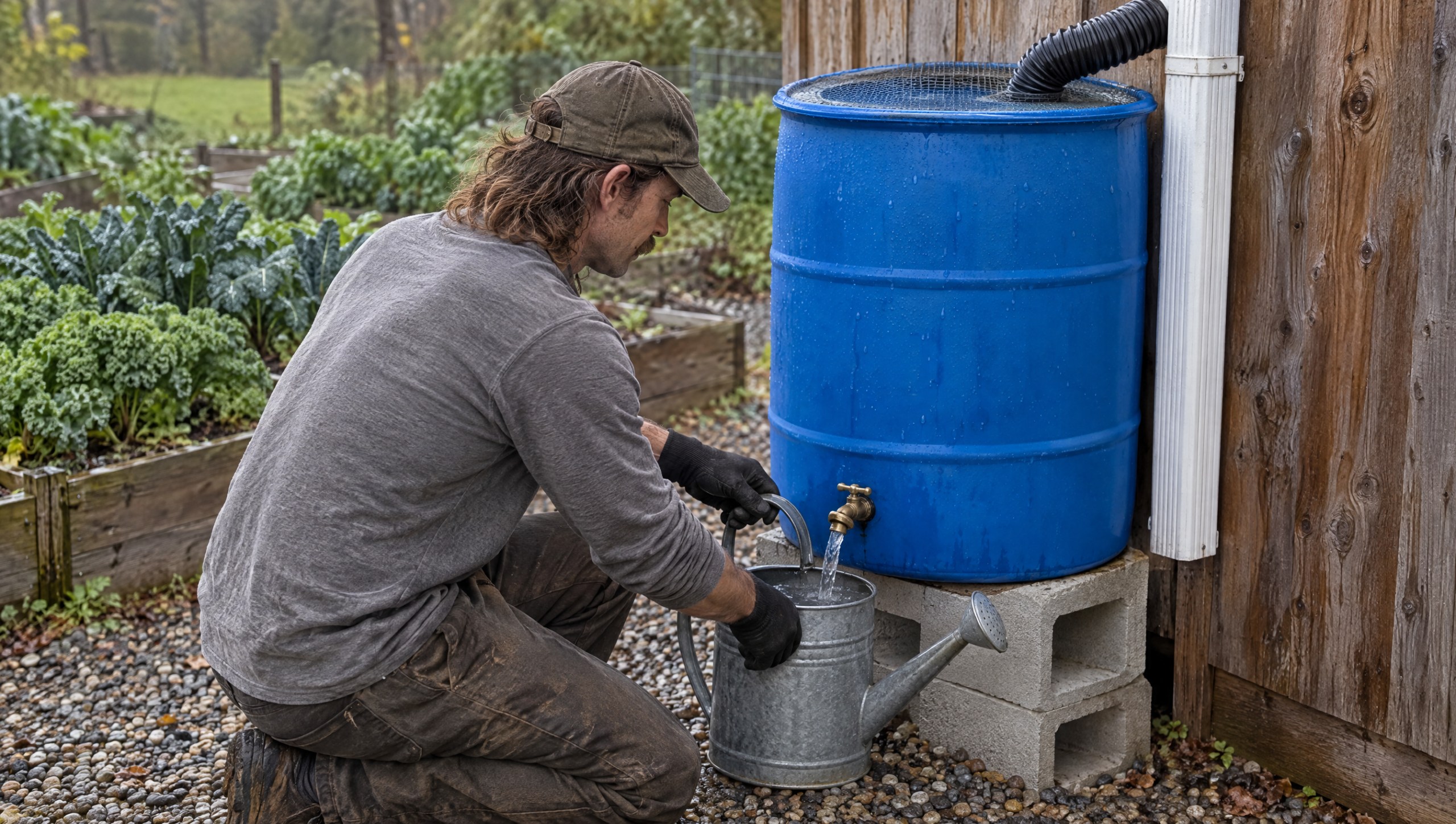

At a Glance: Rainwater Harvesting
- Cost: Rainwater harvesting starts with one barrel and a diverter kit. Plan on roughly $60 to $200 for the parts, depending on the barrel.
- Time: One Saturday morning to set up. Ten minutes a month to check screens.
- Space: One downspout and a level spot about 3 feet across.
- Skill level: Beginner with a hacksaw and a drill. Second-story gutter work goes to a pro.
As an Amazon Associate, we earn from qualifying purchases.
Ever watched a summer storm pour off your roof, then paid to water the garden two days later?
One inch of rain on a 1,000-square-foot roof is over 600 gallons. A single rain barrel catches a small share of that and hands it back to your garden beds when the dry spell hits. Here’s how I set one up so it stays clean and never floods the foundation.
Is Rainwater Harvesting Worth It on a Small Homestead?
Yes, for garden and outdoor chores. Rainwater harvesting gives you free water for the garden, and it slows the runoff that pools by your house.
It’s not drinking water, and it won’t replace your tap. Think of it as a garden tool that fills itself. Here’s what it does well:
- Free water for the garden. Every barrel you fill is water you don’t pay for in July.
- Rain your plants like. Natural rain runs slightly acidic, around pH 5.6, and it carries none of the chlorine that city water does.
- Less water at the foundation. A diverter and an overflow hose move roof water where you want it.
- A backup for outdoor chores. When the well pump loses power, you still have water to rinse tools or top off a garden bed.
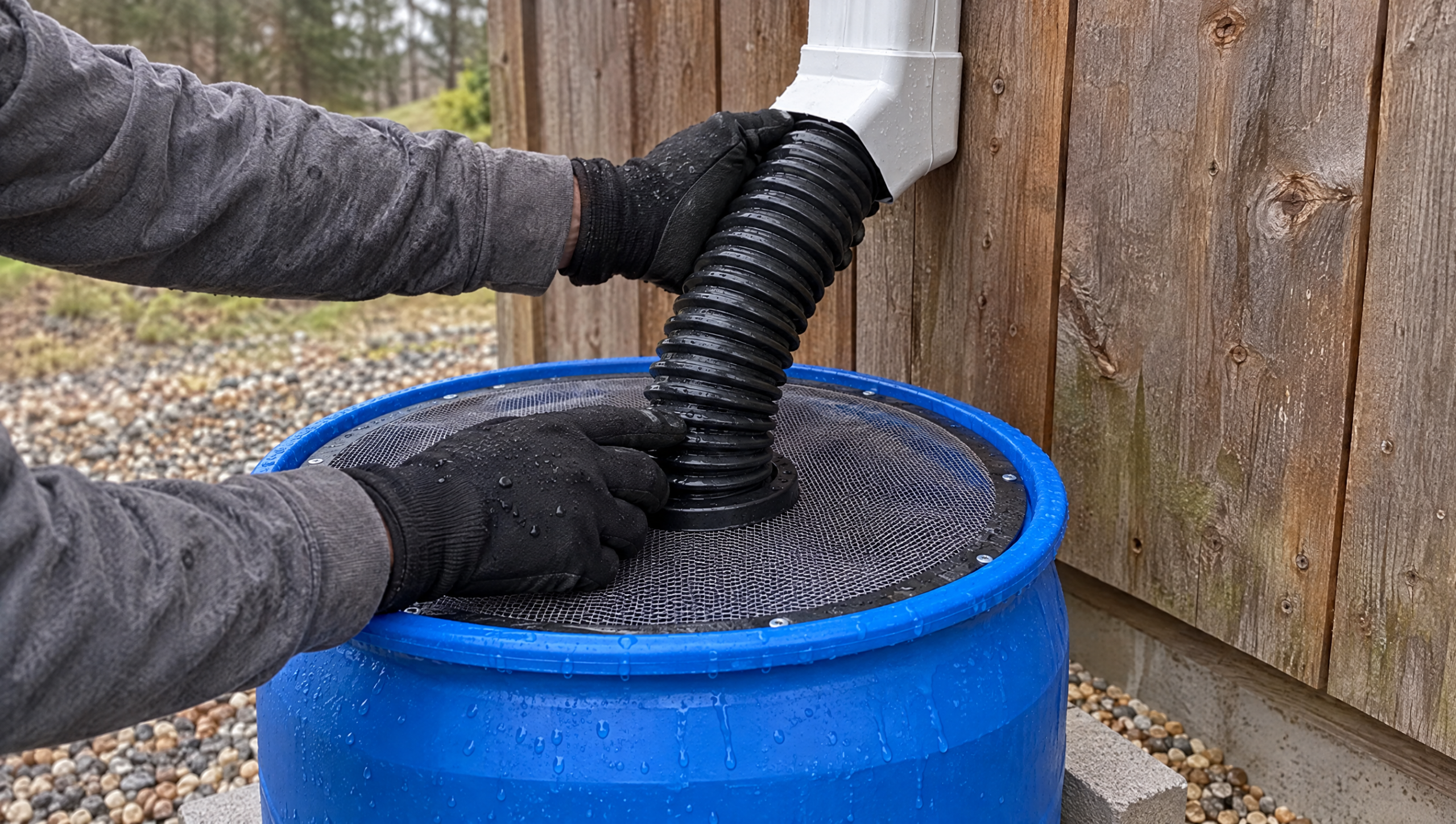
Check Your Local Rules Before You Buy a Barrel
Most of the country lets you catch rain off your own roof. A few places set limits, so check before you buy.
Colorado is the best-known example. State law allows up to 2 rain barrels per home, with 110 gallons total. The water has to stay outdoors on the property where you caught it. Some HOAs also have rules about where a barrel can sit or what color it can be.
A two-minute call to your county or a look at your HOA rules saves you from moving a full barrel later.
How Much Rainwater Your Roof Can Collect
Every square foot of roof sheds about 0.623 gallons for each inch of rain. Multiply your roof area by the inches of rain, then by 0.623.
I do this math on the Project Board before I buy anything. It tells you how fast a barrel fills and whether you need a second one. Measure only the roof section that drains to your chosen downspout, not the whole house.
| Roof area draining to the downspout | Water from 1 inch of rain | First-flush water to divert |
|---|---|---|
| 100 sq ft (small shed) | About 62 gallons | About 1 gallon |
| 500 sq ft | About 312 gallons | About 5 gallons |
| 1,000 sq ft | About 623 gallons | About 10 gallons |
| 1,500 sq ft | About 935 gallons | About 15 gallons |
Gallons use 0.623 per square foot per inch. First flush uses 1 gallon per 100 square feet of roof, per Clemson HGIC. You’ll lose a little more to splash and overflow.
Here’s the surprise most people miss. A small shed roof fills a 55-gallon barrel in one good rain. A house roof fills it in the first few minutes, and the rest goes out the overflow. That’s why the overflow hose matters as much as the barrel.
Pick Your Rain Barrel
Your roof math tells you which barrel fits. Start with the smallest one that matches your garden, then add a second barrel later if it keeps overflowing.
As an Amazon Associate, we earn from qualifying purchases.
Starting small: a fold-flat barrel
If you’re testing the idea on a patio or a small bed, a soft-sided barrel sets up in minutes and folds away for winter. It sits low, so plan on a watering can rather than a hose. (paid link)

- Save your rain water for those dry days
- Made of flexible, puncture-resistant, laminated polyester that folds flat when not in use
- Mesh top keeps out debris and zips open for easy dripping
The standard: a 55-gallon rain barrel
A rigid 55-gallon rain barrel is where I’d start most people. It’s sturdy enough to raise on blocks for better hose pressure. Before you buy, check the listing for the spigot and inlet setup, and remember it needs a level stand. (paid link)

- 55-Gallon Capacity: Large 55-gallon rain barrel gives you ample water storage for watering your garden, lawn, and plants without...
- Metal Spigot & Overflow: Includes a metal spigot for easy hose hook-up; Two optional spigot placement locations let you configure the...
- Debris-Blocking Screen: Built-in mesh screen avoids debris and leaves from entering your water supply, ensuring clean water collection...
If you’d rather convert a drum yourself, use one that held food, never chemicals.
Bigger roofs: an IBC tote
An IBC tote holds 275 gallons. That’s a lot of garden water, and it’s also more than a ton of weight when full. It needs a solid, level pad, and it can bump into local limits like Colorado’s.
What You Need
You can find most of this at a hardware store. Buy the barrel last, once you know your roof math and where it will sit.
Tools:
- Hacksaw for cutting the downspout
- Drill with a hole saw sized to your spigot and diverter hose
- Tape measure and a level
- Shovel or rake to level the ground
Materials:
- Food-grade barrel with a lid
- Downspout diverter kit that sends water back down the spout when the barrel is full
- First-flush diverter sized at about 1 gallon per 100 square feet of roof
- Fine-mesh screen for every opening
- Brass spigot and waterproof sealant
- Concrete blocks and sand or gravel for a level base
- Overflow hose long enough to reach a rain garden or gravel strip
- Mosquito dunks (BTI) for long dry spells
How to Build a DIY Rainwater Harvesting System
This build takes one morning. Do the steps in this order, because the base has to be right before anything gets heavy.
1. Level the base
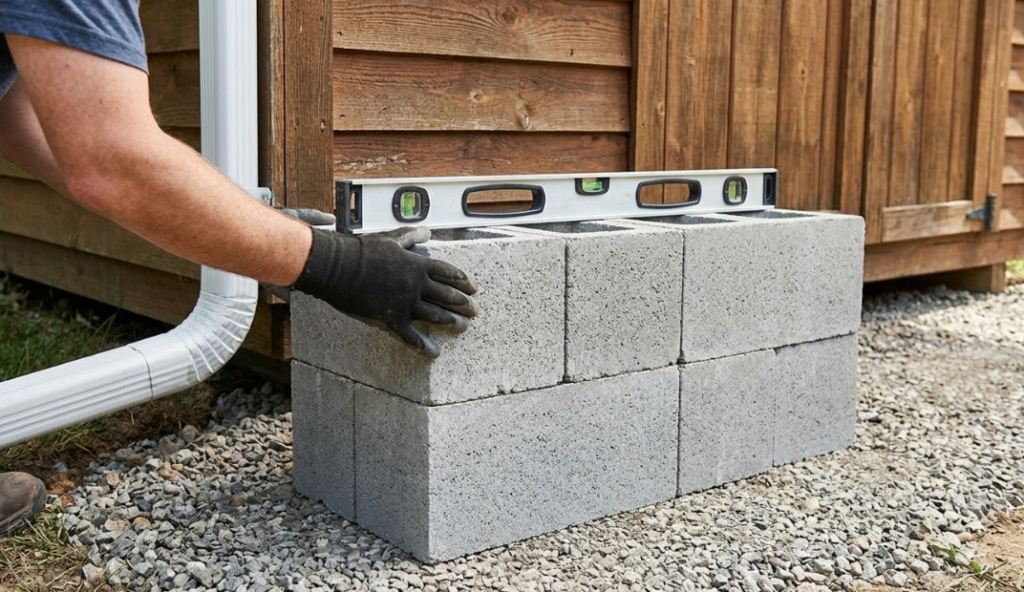
Water weighs about 8.3 pounds a gallon. A full 55-gallon barrel is about 460 pounds, so a tippy base is a real hazard.
Rake the spot flat and spread a layer of sand or gravel. Set your concrete blocks on top. Raising the barrel a foot or more gives you better hose pressure. Penn State Extension recommends the same block-and-gravel base.
CHECKPOINT: Set a level across the top of the blocks before the barrel goes on. Push hard on one corner. If it rocks or sinks, fix the base now. You can’t fix it with 460 pounds of water on top.
2. Install the downspout diverter
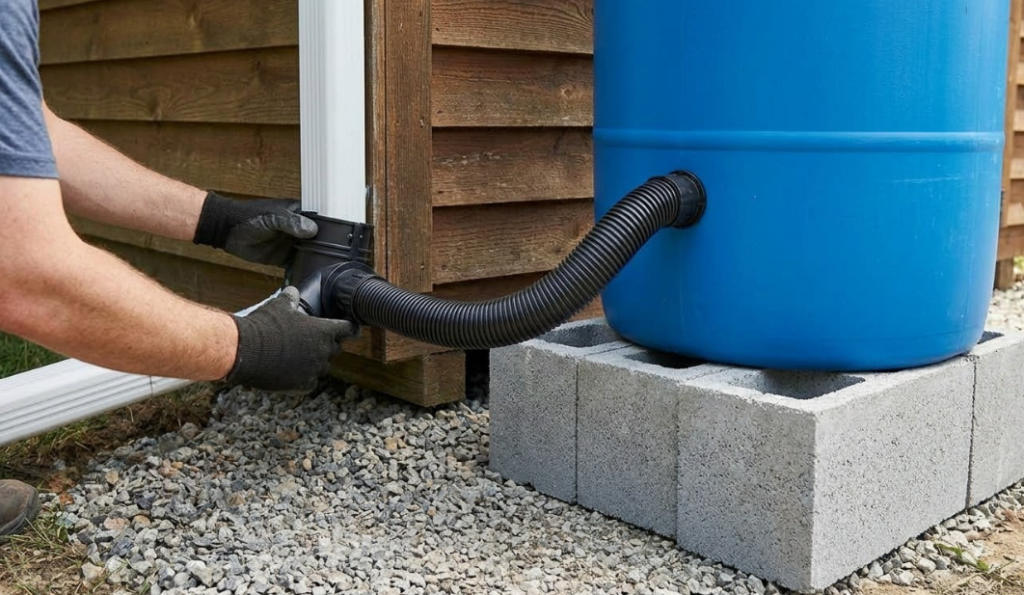
Mark the downspout a little above the top of the barrel. Cut out the section your kit calls for and fit the diverter in its place. When the barrel fills, the diverter sends extra water back down the spout instead of over the barrel’s rim.
3. Add a first-flush diverter
The first rain off a roof carries the most grit and bird droppings. A first-flush diverter catches that dirty water and lets the cleaner rain through.
Size it at about 1 gallon for every 100 square feet of roof. This first-flush diverter kit is made for round downpipe, so measure yours first; a rectangular downspout needs an adapter. (paid link) Empty it after each storm so it’s ready for the next one.
4. Screen every opening
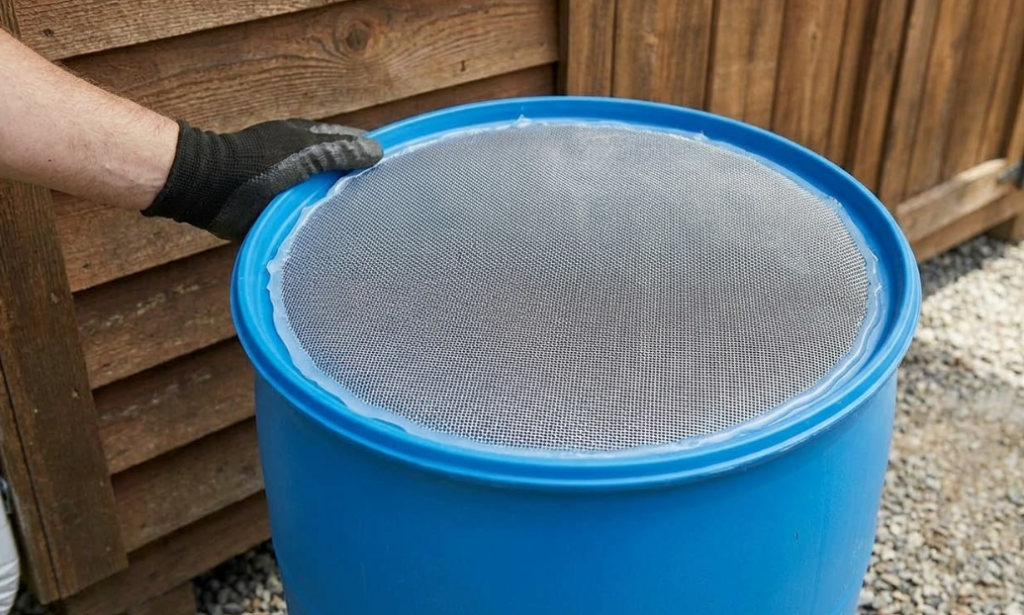
Mosquitoes will lay eggs in any open water. Cover the inlet and any other opening with fine mesh, and make sure the lid sits tight. This also keeps leaves out, which keeps the water from going sour.
5. Fit the spigot
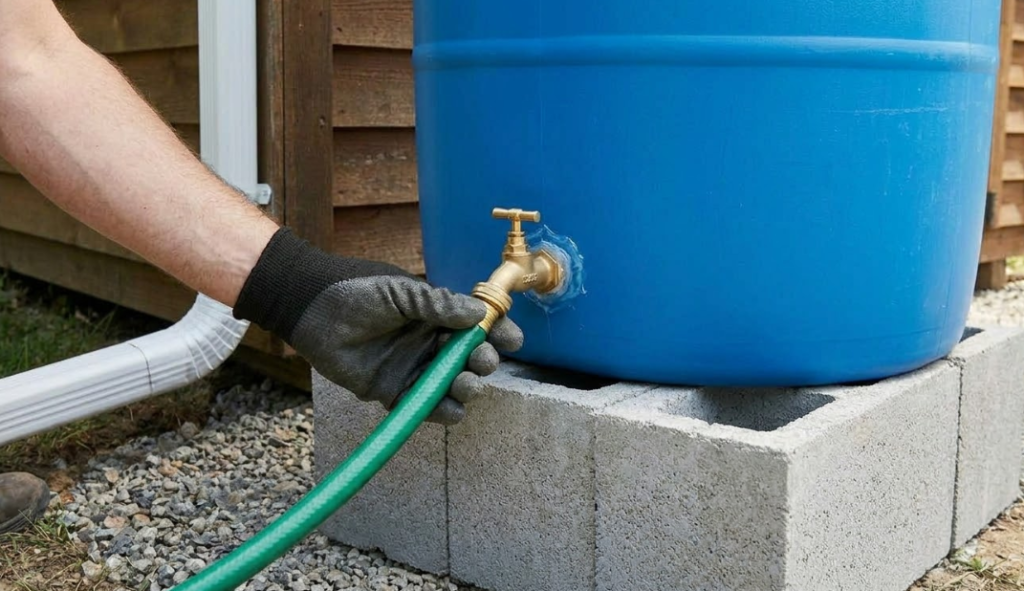
Drill a hole near the bottom, a few inches up so the spigot clears the blocks. Thread in a brass spigot with sealant on both sides. Let the sealant cure as long as the label says before you fill the barrel.
6. Run the overflow away from the house
Attach a hose to the overflow port and lead it at least a few feet from the foundation. A rain garden or a gravel strip makes a good landing spot.
CHECKPOINT: Run a hose into the barrel until it overflows. Watch where the water goes. If it pools near the foundation, move the overflow hose before the next storm.
Using Rain Barrel Water on Your Garden
Rain barrel water is great for flower beds and shrubs. For vegetables, extension services agree on one rule: water the soil, not the plant.
Your roof shapes what’s in the barrel. Studies find metal and tile roofs tend to give cleaner runoff, while shingle roofs carry more organic matter and bacteria. No roof is perfectly clean, which is why the first flush and the screens matter.
How to water edibles with rainwater
Clemson HGIC and UConn Extension give the same practical steps:
- Water at the soil. Use a watering can or a soaker hose at the base of the plant. Don’t spray the leaves.
- Water in the morning. Let leaves dry in the sun before you pick.
- Skip harvest day. Don’t water edibles with barrel water the day you harvest.
- Wash your harvest with tap water. And wash your hands after handling barrel water.
Not every extension service goes that far. Penn State advises using rain barrel water only on plants you won’t eat, as a 2026 Sea Grant review notes. So if you grow leafy greens you eat raw, the safest call is tap water for those beds and barrel water for everything else.
STOP POINT: Don’t drink barrel water or cook with it. Keep it out of pet water bowls too. A rain barrel isn’t a drinking water system. Making rainwater safe to drink takes a system designed for it.
Keep Your Rain Barrel Clean All Year
A barrel that’s checked a few times a season stays clean for years. Most problems start with a clogged screen or a barrel left full too long.
- Gutters: Clean them at least twice a year.
- Screens and first flush: Clear them about four times a year, and after big storms.
- Dry spells: If it hasn’t rained in a few weeks, use up the water and let it refill. Stale water is where smells and mosquitoes start.
- Wigglers: If you spot them, patch the gap and drop in a mosquito dunk. It’s a backup, not a fix. The screen and a tight lid do most of the work. (paid link)
- Algae: Keep the barrel in shade or use an opaque barrel. Light feeds algae.
- Winter: Empty the barrel and disconnect it before the first freeze. Store it in a shed or garage, or flip it upside down and tie it down. Reconnect it in spring.
If you’re getting the house ready for cold weather, add the barrel to your winterizing checklist.
Quick Fixes for Common Rain Barrel Problems
Most rain barrel trouble has a simple cause. Here’s what I check first.
| What you see | Likely cause | Fix |
|---|---|---|
| Green water | Sunlight reaching the water | Move the barrel to shade or switch to an opaque barrel |
| Wigglers in the water | Gap in the screen or lid | Patch the screen, seal the lid, add a mosquito dunk |
| Rotten-egg smell | Water sitting too long, or leaves in the barrel | Empty and scrub the barrel, then clear the gutters and screen |
| Weak hose flow | Barrel sits too low, or debris in the spigot | Raise it on blocks and clear the spigot |
| Water by the foundation | Overflow hose too short | Extend it to a bed or gravel strip |
| Cracked barrel in spring | Left full over winter | Replace it, and empty and store it before the first freeze |
Shortcuts That Backfire
These tips show up online a lot. Each one costs you water quality or a barrel.
- “Any old drum will do.” A barrel that held chemicals can’t be cleaned enough for garden water. Buy food-grade, and know what was in it.
- “Rainwater is pH-neutral.” It isn’t. Natural rain runs slightly acidic, around pH 5.6. Plants handle it well, but don’t count on it to fix alkaline soil, and don’t treat it as pure.
- “Spray it right on the veggies.” Extension services say water the soil, not the leaves, on anything you’ll eat.
- “Leave the top open so it fills faster.” An open barrel turns into a mosquito nursery in a week.
- “Filter it and drink it.” A barrel and a pitcher filter aren’t a drinking water system.
- “Leave it full all winter.” Ice cracks plastic barrels and spigots.
When to Call a Pro
Most rain barrel setups are a weekend DIY job. Call a pro when the job moves past one barrel on the ground floor.
- High gutters: Any work from a ladder on a second-story gutter.
- Big tanks: A tank or cistern large enough to need a poured pad, or anything tied into a structure.
- Indoor plumbing: Any plan to pipe rainwater into the house, including toilets or laundry.
- Drinking water: Any system meant to make rainwater safe to drink.
- Foundation problems: Water that keeps pooling against the house even with the overflow moved.
Buy Once
Pick the setup that matches your roof math. Bigger isn’t better if it overflows on day one.
- Best: A 55-gallon rain barrel on blocks, with a diverter kit and a first-flush diverter. (paid links)
- Budget: A 75-gallon fold-flat barrel for a patio or one bed. Easy to store in winter. (paid link)
Start With One Barrel
One barrel on one downspout teaches you how your roof and your rain behave. Watch how fast it fills and where the overflow goes.
By next summer you’ll know if you want a second barrel or a bigger tank. If you’re ready to build one from scratch, my DIY rain barrel guide walks through the drilling. For larger setups, see rainwater harvesting systems.
FAQs
How much water can rainwater harvesting collect from my roof?
About 0.623 gallons per square foot of roof for every inch of rain. A 1,000-square-foot roof sheds over 600 gallons in a 1-inch rain. Measure only the part of the roof that drains to your downspout, and expect to lose some to the first flush and overflow.
Is rainwater harvesting legal in my state?
Most states allow rainwater harvesting from your own roof, but some set limits. Colorado, for example, allows up to 2 barrels and 110 gallons total per home, for outdoor use on that property. Check with your county and your HOA before you buy.
Can I drink water from a rain barrel?
No. A rain barrel is for garden and outdoor use only. Barrel water can carry bacteria from bird droppings and metals from roofing. Making rainwater safe to drink takes a system designed and tested for it, so talk to a pro if that’s your goal.
How do I keep mosquitoes out of a rain barrel?
Screen every opening with fine mesh and keep the lid tight. During a long dry spell, use up the water every few weeks so it doesn’t sit. If you see wigglers, patch the gap and drop in a mosquito dunk.
Is rain barrel water safe for a vegetable garden?
Extension services split on this. Clemson and UConn say it’s fine at the soil level, watered in the morning, not on harvest day, with produce washed in tap water. Penn State says to use it only on plants you won’t eat. If you’re unsure, keep it off leafy greens you eat raw.
Would You Water Your Vegetables With Rain Barrel Water?
What kind of roof feeds your barrel, and what made you decide? Tell us below.
Leave a Comment