
At a glance
- Cost: Learning how to split firewood by hand starts with a maul or splitting axe plus safety glasses. That ran about $70 to $90 on Amazon in October 2026. A steel wedge adds a little more.
- Time: Split in 30 to 45 minute sessions. Then the wood dries for at least 6 months.
- Space: A flat spot with a clear circle around you: one arm’s length plus three tool lengths.
- Skill level: Beginner with a maul. Felling trees and big chainsaw work need a pro.
An 8-pound maul and a flat block will split most stove wood. The swing matters less than the setup.
Set the round on a wide block. Stand square to it. Aim for a crack or the outer edge, and let the weight of the head do the work. Below is how I set up, both hand methods, and how to stack the wood so it’s dry enough to burn next winter.
As an Amazon Associate, we earn from qualifying purchases.
Which tool should you split firewood with?
Pick the tool that fits your rounds and your arms. A maul you can’t swing straight splits less wood than a lighter tool you can control all morning.
Here’s how the three options compare.
Splitting maul
A splitting maul has a heavy, blunt head, from 6 to 8 pounds. The weight drives it through big rounds. University of Missouri Extension says an 8-pound maul gives the best results for anyone splitting less than 10 cords a year. That covers most households.
Splitting axe
A splitting axe is lighter, from 3 to 6 pounds, with a sharper head (Husqvarna). It’s quick on small and medium rounds, and on chunks off the edge of a big one.
If an 8-pound maul wears you out in ten swings, start here.
Wedges and a sledge
Steel wedges and a 6 to 8 pound sledgehammer handle the rounds a maul bounces off, like knotty or stringy wood. It’s slower. It’s also more controlled. Two wedges live on the Back Bench all winter at my place.
What you need to split firewood by hand
Once you’ve picked a tool, the rest of the list is short. Spend on the striking tool. The rest is cheap.
As an Amazon Associate, we earn from qualifying purchases.
For big rounds
A maul does the heavy work. Add a steel splitting wedge for the rounds that won’t open.
For big rounds and a steady swing, this 8-pound maul has a 36-inch handle that shrugs off a missed strike:

- MULTI-USE AXE: Sharp blade axe with inseparable riveted head is an ideal wood chopper designed for firewood, yard work, and lawn...
- EFFICIENT AND COMFORTABLE USE: IsoCore shock-absorbing handle with textured non-slip grip reduces hand strain, improves control, and...
- LONG-LASTING AND RELIABLE: Steel blade stays sharper longer than traditional axes while advanced blade geometry splits tough logs...
For smaller rounds or a lighter tool
A splitting axe is easier to control and still splits most stove-size wood.
For a lighter tool, this splitting axe is quick on medium rounds and edge chunks:

- MULTI-USE AXE: Sharp blade axe is an ideal wood chopper designed for firewood, yard work, and lawn cleanup, with maximum efficiency for...
- EFFICIENT AND COMFORTABLE USE: Shock-absorbing handle with textured non-slip grip reduces hand strain, improves control, and prevents...
- LONG-LASTING AND RELIABLE: Hardened forged steel blade stays sharper longer than traditional axes and advanced bevel convex design...
For everyone
- Safety glasses: chips and bark fly at face height. Get a pair marked ANSI Z87.1.
- A pin moisture meter: the only way to know the wood is dry. Most hardware stores keep these with the paint supplies, not the firewood.
- Leather gloves and leather boots: the pair you already own is fine.
Set up a safe splitting spot
Here’s the part people skip. Most splitting injuries start before the first swing, with a bad block or someone standing too close.
Ten minutes of setup fixes both.
Build a solid block
Use a wide hardwood round with both ends cut flat. Set it on firm, level ground. Bare dirt and concrete are both bad. The blade buries itself in one and bounces off the other.
Set the height so the handle is about level when the head hits the top of a round. Too high and you lose power. Too low and the head can carry past.
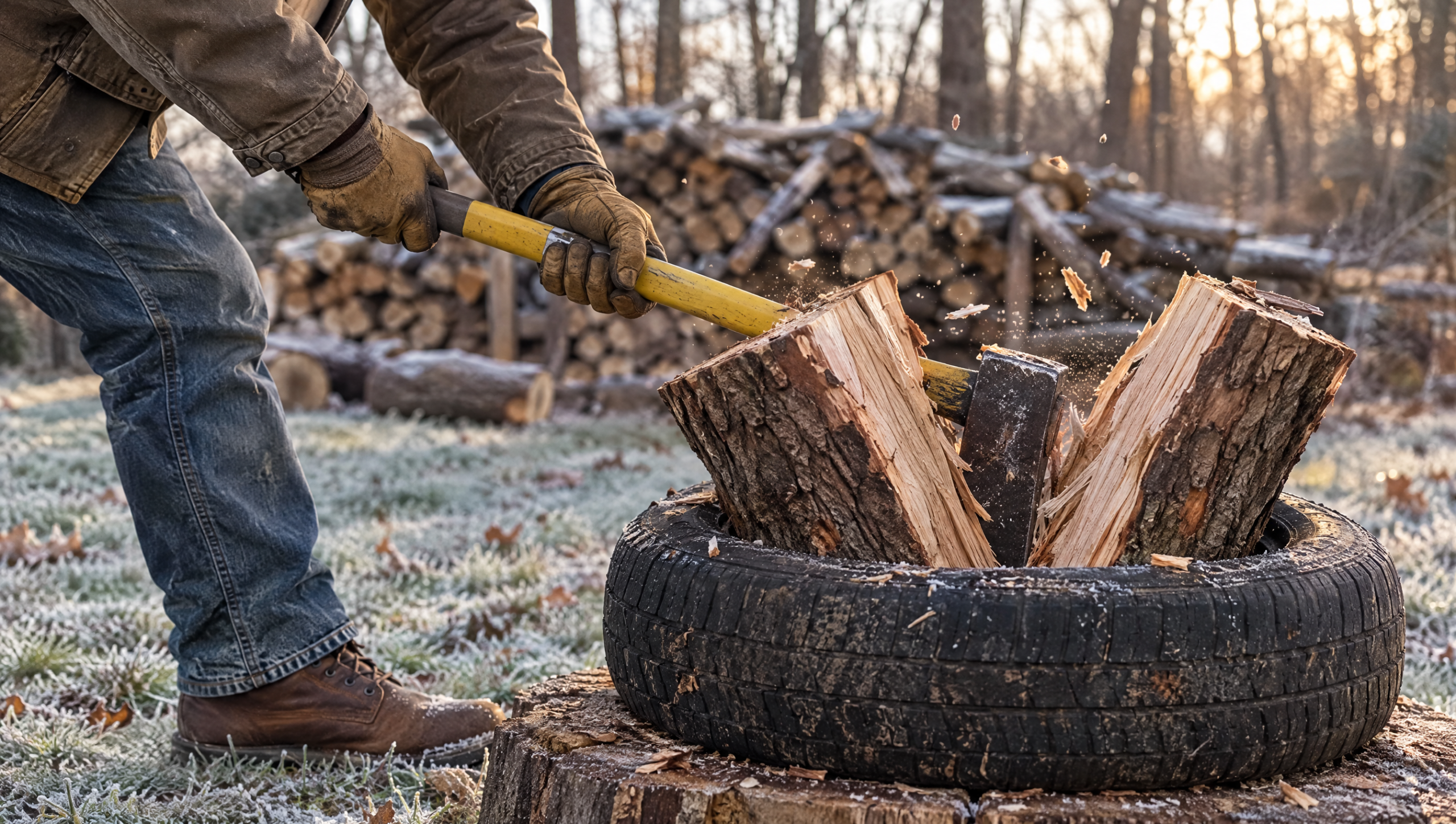
An old car tire over the block holds the round up and keeps split halves from flying off (MU Extension).
Clear a circle around you
The National Park Service rule for axe work is one arm’s length plus three tool lengths, clear of anything that could knock the blade off course (NPS axe safety analysis). That means branches and fence wire. It also means people.
Otis likes to nap wherever split pieces land, so he goes inside before I start.
Gear up
Wear safety glasses and leather boots. Add leather gloves. That’s the same gear the Park Service lists for axe work (NPS).
Check the tool
Twist the head on the handle. It shouldn’t move. Look for cracks or splinters in the handle. OSHA warns that a loose or cracked handle can let the head fly off.
CHECKPOINT: Before the first swing: the block sits flat, the circle is clear, and your glasses are on. The head doesn’t move when you twist it. Fix anything that fails.
How to split firewood with a maul
This is the method you’ll use most. Go slow at first. Accuracy beats force, and the speed shows up on its own.
- Set one round on the block. Put the flattest end down. If it rocks, flip it or trim it. A rocking round makes the blade glance off.
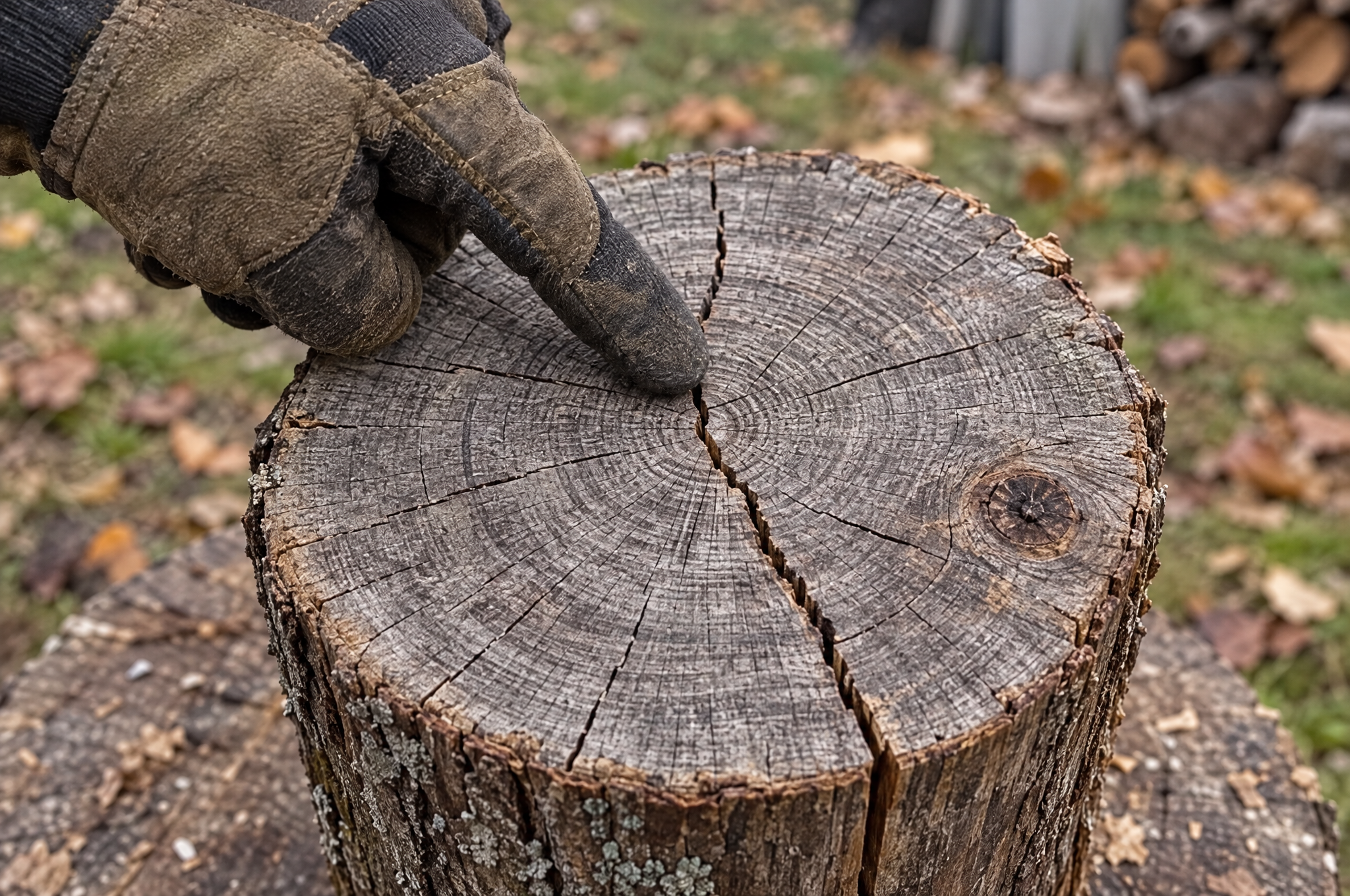
- Read the wood. Look for cracks across the top, called checks. Those are free splits. Note any knots. Missouri Extension calls this reading the wood.
- Pick your spot. On a small round, aim along the biggest check through the center. On a big round, split pieces off the outside edge first and work in. If there’s a big knot, swing so the blow lands crosswise to it, or split around it.
- Square up. Face the block with your feet about shoulder width apart. Step back until the head rests on your target with your arms straight. That’s your distance.
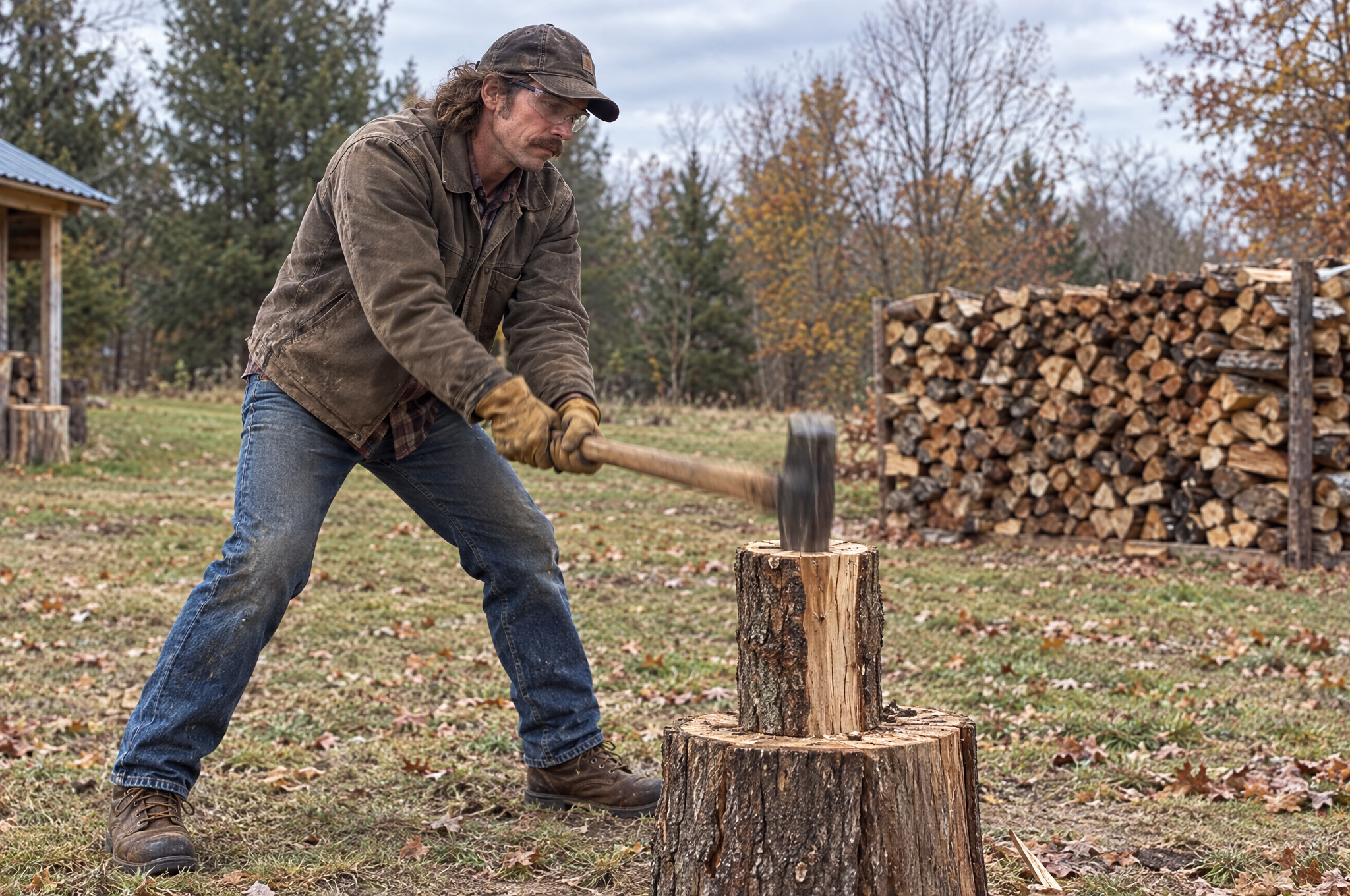
- Swing straight. Start with your hands apart on the handle and lift the maul overhead. As it comes down, slide your top hand down to meet your bottom hand. Keep your eyes on the target.
- Bend your knees as it lands. That drops the head lower. A miss goes into the block or the ground instead of your shin.
- Keep going. Split halves into quarters until the pieces fit your stove. Missouri Extension lists 16 inches as a common length, but measure your firebox first (MU Extension).
STOP POINT: A stuck maul tempts you to grab a sledgehammer. Don’t, unless the maker says the back of that maul is built to be struck. Never hit a splitting axe. Tap a wedge into the crack beside it instead. And when your swings start drifting, you’re done for the day.
CHECKPOINT: After five rounds, look at your misses. Glancing to the side means the round isn’t flat or your feet aren’t square. Landing short means step in a few inches.
Watch the stance and the hand slide, then follow the steps above. Video: Art of Manliness.
How to split tough rounds with wedges
Some rounds won’t open. Elm and knotty crotch wood fight back.
Wedges trade speed for control, and they save your shoulders.
- Set the round on the block. Same block, same clear circle, same glasses.
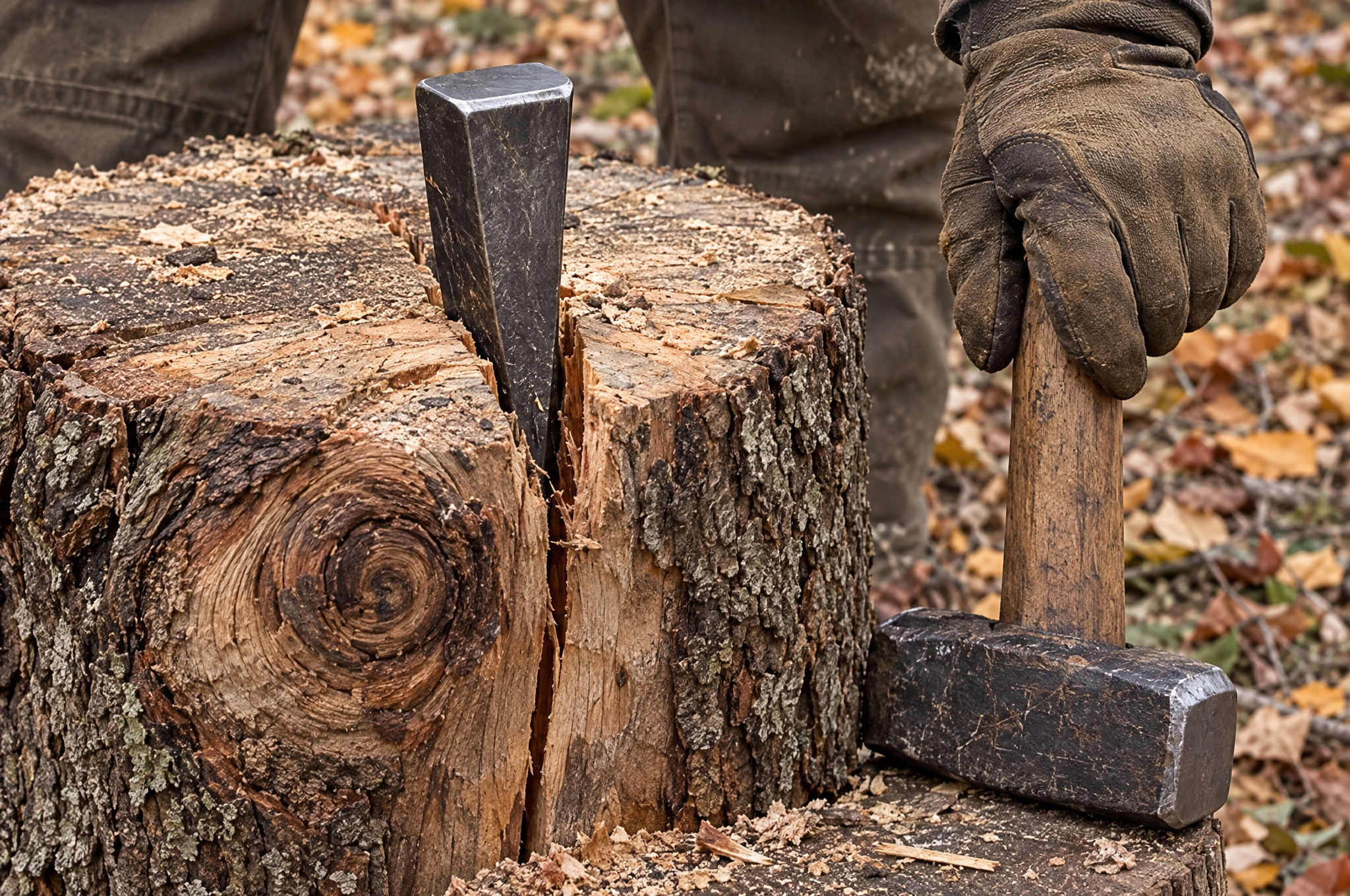
- Start the wedge in a check. Hold it like a nail and tap it with the sledge until it stands on its own. Move your hand away before the next swing.
- Drive it with steady blows. Medium, steady swings. Stand off to the side of the wedge’s line, so a wedge that pops out doesn’t fly at your feet.
- Add a second wedge. If the first one sinks and the round still holds, set a second wedge in the crack it opened. Drive it to free the first.
- Cut the hanging fibers. Halves often hang together by long fibers. Chop through them with the maul or a hatchet, then split the halves to size.
STOP POINT: Look at the wedge heads before every session. If the striking face has a curled, mushroomed rim, grind it smooth or replace the wedge. OSHA warns those rims can shatter on impact.
CHECKPOINT: Each wedge should go in straight and stay put between blows. A wedge that springs back has hit a knot. Move it to a different check.
Stack it so it dries
Split wood still holds water. Wet wood wastes heat drying itself in the stove and builds creosote in the chimney (University of Kentucky Extension).
Here’s how to stack it, and how to prove it’s ready.
Stack it off the ground
Set the stack on pallets or rails, in a sunny spot where wind moves through it (MU Extension). Crisscross the ends so the stack stays upright (Illinois Extension). Keep it off the house siding.
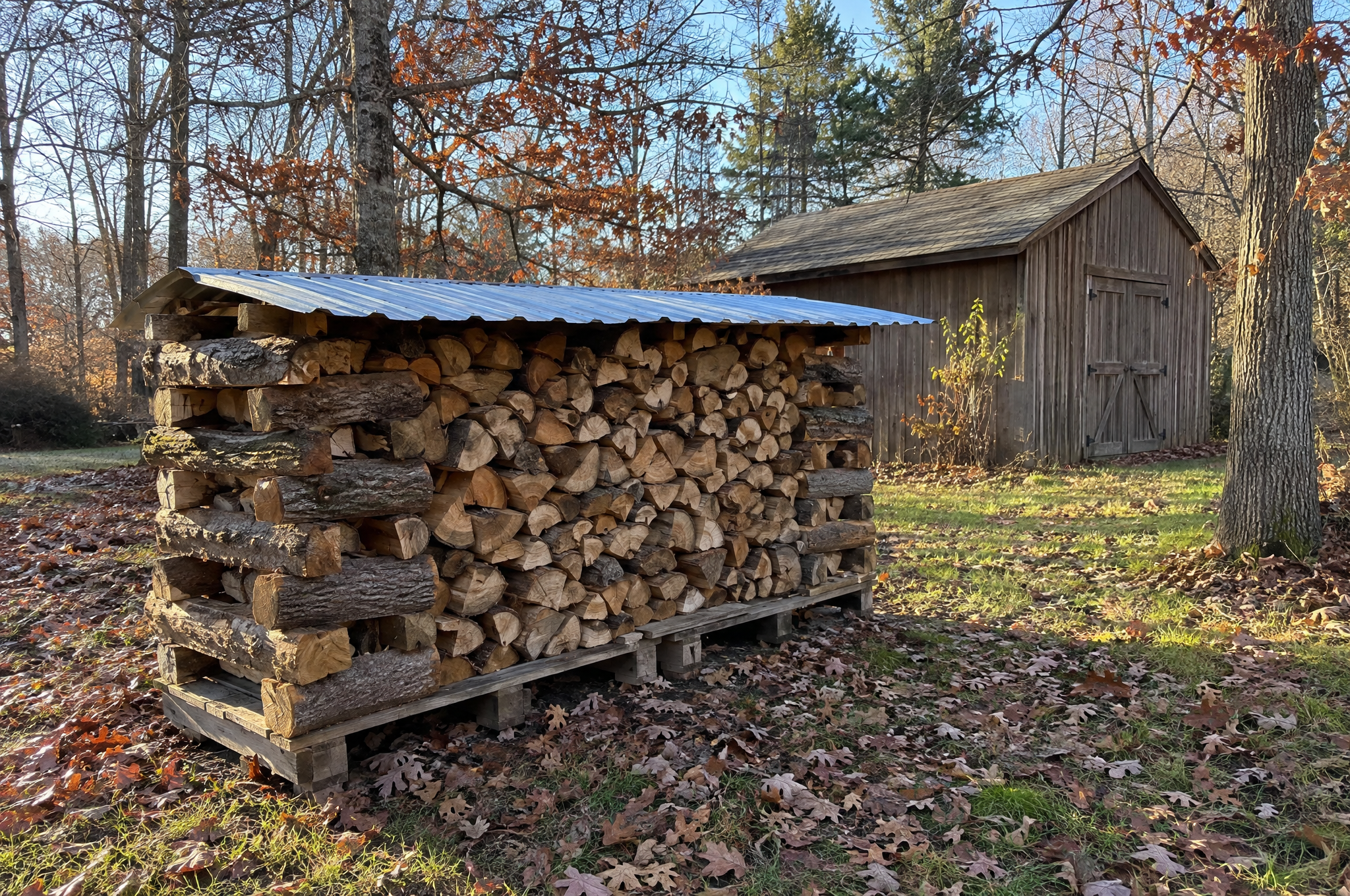
Cover the top only
Lay metal roofing or a tarp over the top. Leave the sides open so moisture can leave (University of Alaska Fairbanks).
Give it time
Plan on at least 6 to 9 months outdoors (Illinois Extension). Your climate and the type of wood decide where in that range you land.
Fresh-cut wood can be 50% water or more. You want it at 20% or less when you burn it (MU Extension).
Test it before you burn it
Split one piece and push the meter pins into the fresh inside face. The outside dries first and can fool you (UAF). Dry wood also shows gray ends with cracks across them.
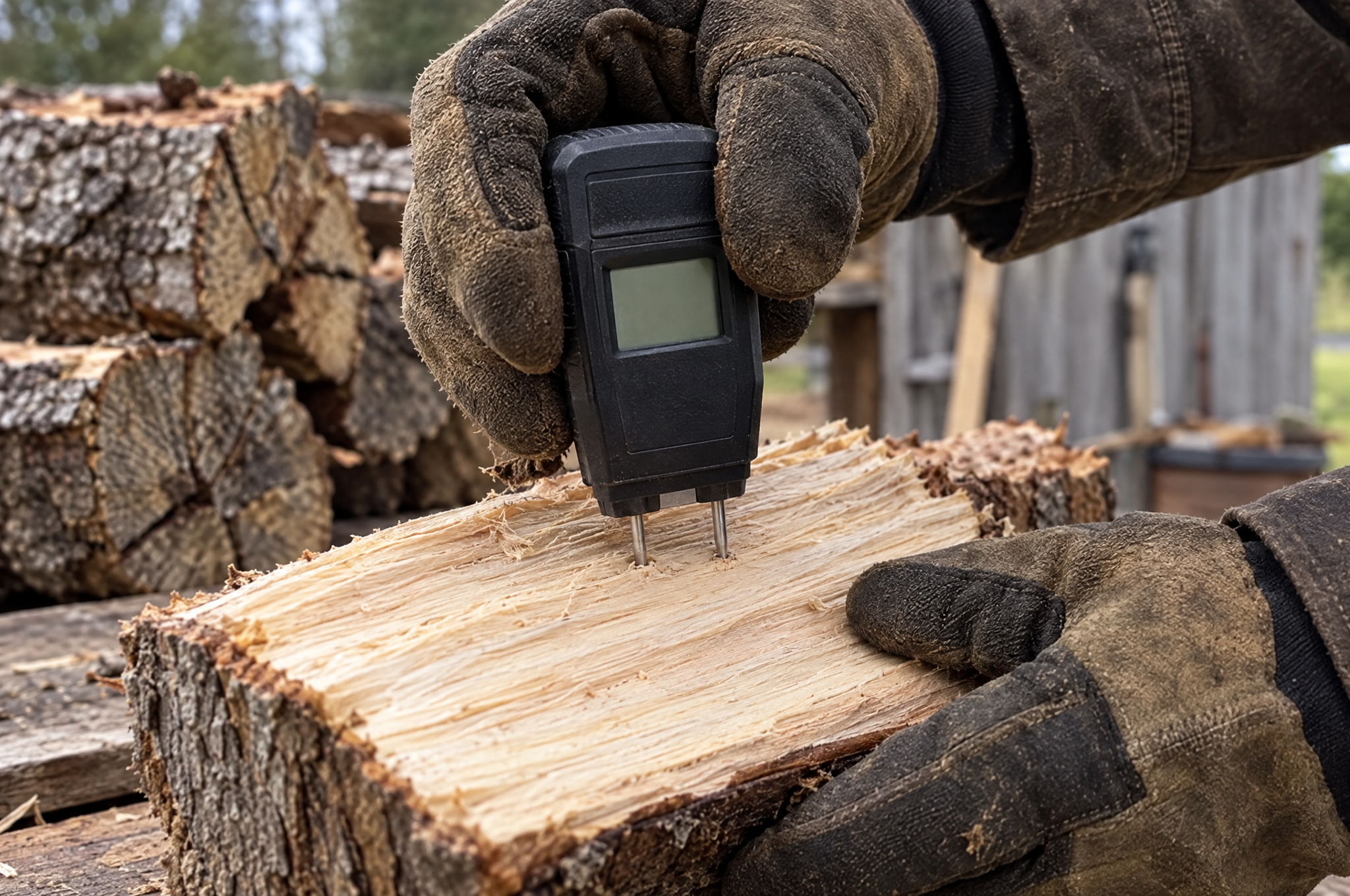
CHECKPOINT: A reading of 20% or less on a fresh split face means it’s ready. Over that, give it more time. The readings go on the Project Board with the date and the wood type, so next year’s plan starts with numbers.
Bring in one week’s worth at a time. That keeps bugs in the woodpile and out of the house (Illinois Extension). For which woods burn best, see our guide to the best firewood for winter.
Troubleshooting
Most splitting problems start with the setup. Find the symptom and start with the fix.
| Symptom | Likely cause | Fix |
|---|---|---|
| The maul bounces off | You’re hitting the center of a big round | Split from the outside edge first. Split green wood when you can. |
| The blade glances sideways | The round isn’t flat, or your feet aren’t square | Flip or trim the round. Reset your stance. |
| The head gets stuck | Stringy or knotty wood | Tap a wedge in beside it. Never strike an axe. |
| The halves won’t separate | Long fibers holding on | Chop the fibers. Turn the piece and hit from the other side. |
| Your shoulders ache fast | The tool is too heavy, or you’re swinging with your arms | Try a splitting axe. Let the weight drop. Bend your knees. |
| The wood hisses in the stove | It’s still wet | Meter test. Restack it and give it more months. |
Common mistakes and the fix
You’ll see these shortcuts online. Each one saves a minute and costs more later.
- Mistake: Splitting on the ground or a driveway. Fix: Use a wide, flat block every time.
- Mistake: Hitting an axe with a sledgehammer to drive it through. Fix: Set a wedge in the crack and drive the wedge.
- Mistake: Letting someone hold the log. Fix: Use a tire on the block. Nobody’s hands go near a swing or a splitter ram.
- Mistake: Splitting today and burning tonight. Fix: Stack it, cover the top, and meter test before it goes in the stove.
- Mistake: Wrapping the whole stack in a tarp. Fix: Cover the top only so the sides can dry.
Keep your tools ready for next season
A maul doesn’t need much care. Skip it, though, and the tool you trusted last fall gets dangerous.
- Check the head and handle before every session. A head that moves gets fixed or replaced before you swing it again.
- Touch up the edge with a file when it rolls or chips. A maul doesn’t need to be sharp like a knife, but a clean edge bites better.
- Grind mushroomed rims off your wedges as soon as they show up.
- Store tools dry and off the ground. Rust on the head and a swollen wood handle are both easier to prevent than fix.
Where DIY stops, and what about a log splitter?
Splitting rounds is beginner work. Dropping a tree and cutting a trunk into rounds is where the DIY part stops for most people.
Call a pro when:
- A tree needs to come down, especially one leaning toward a house or power line.
- Trunks are too big to cut into rounds safely with the saw and skills you have.
- You have a back or heart condition. Ask your doctor before heavy splitting.
- The chimney hasn’t been inspected this year. A chimney sweep should look at it before your first fire. Our wood stove tips cover the rest.
If you burn a lot of wood or get knotty hardwood, a hydraulic splitter can save your back. Rent one for a weekend before you buy.
STOP POINT: A log splitter is a one-person machine. Never hold the log while the ram moves. Keep people and pets far back. One maker’s manual sets that at 16.5 feet (splitter manual). Wear safety glasses and follow your machine’s manual exactly.
Hand and machine splitting side by side. Follow your splitter’s manual for safety. Video: This Old House.
Buy once
You don’t need much. Buy the striking tool once and keep it maintained, and it’ll last decades.
As an Amazon Associate, we earn from qualifying purchases.
Cheap is fine. Cheap twice isn’t.
- Best: An 8-pound splitting maul, a steel wedge, and a 6 to 8 pound sledge. That handles any round you’ll meet.
- Better: A splitting axe and one wedge. Plenty for stove-size wood and smaller rounds.
- Budget: Borrow a maul for your first season. Put the money into safety glasses and a moisture meter.
Before the first fire of the season
Split in short sessions and stack with the top covered. Meter test before anything goes in the stove. For the rest of the cold-weather list, see the winterizing your home plan, and for the first fire, try a homemade fire starter.
Then check the maul head one more time and hang it somewhere dry.
Questions people ask about splitting firewood
What’s the safest way to learn how to split firewood?
Start with straight, small rounds and a tool you can control. Set the round on a flat block and clear a circle around you. Wear glasses and boots. Bend your knees as the head lands, so a miss goes into the block. Split in short sessions and stop when your swing gets sloppy.
Should you split firewood green or after it dries?
Split it green when you can. University of Missouri Extension says fresh-cut wood splits easier. Splitting early also helps it dry, because more of the wood is open to the air. Then stack it with the top covered and give it at least 6 months.
Why does my maul keep bouncing off the round?
You’re hitting the dead center of a big round, or the round isn’t sitting flat. Split pieces off the outside edge first and work toward the middle. Make sure the round doesn’t rock, and aim along an existing crack. On small rounds, a splitting axe can bite better.
Can I hit my splitting axe with a sledgehammer?
No. An axe isn’t built to be struck, and the steel can chip or the head can loosen. If an axe or maul gets stuck, tap a wedge into the crack beside it. Only strike a maul’s back if the maker says it’s designed for that.
Is a log splitter worth buying?
It depends on how much you burn and what wood you get. For a small woodpile of straight rounds, a maul and a wedge cost far less and work fine. For lots of knotty hardwood, a splitter can save your back. Rent one for a weekend first. Either way, it’s a one-person machine.
Hot-take poll
Defend your pick in the comments. Winning argument gets pinned.