

At a Glance: Vegetables to Plant in September
- Count back from your first frost date, not the calendar.
- Pick 3 crops that fit the weeks you have left, then plant this weekend.
- Check soil temperature first. Warm soil keeps cool-season seed asleep.
Are your summer pots done, and is it too late to plant anything?
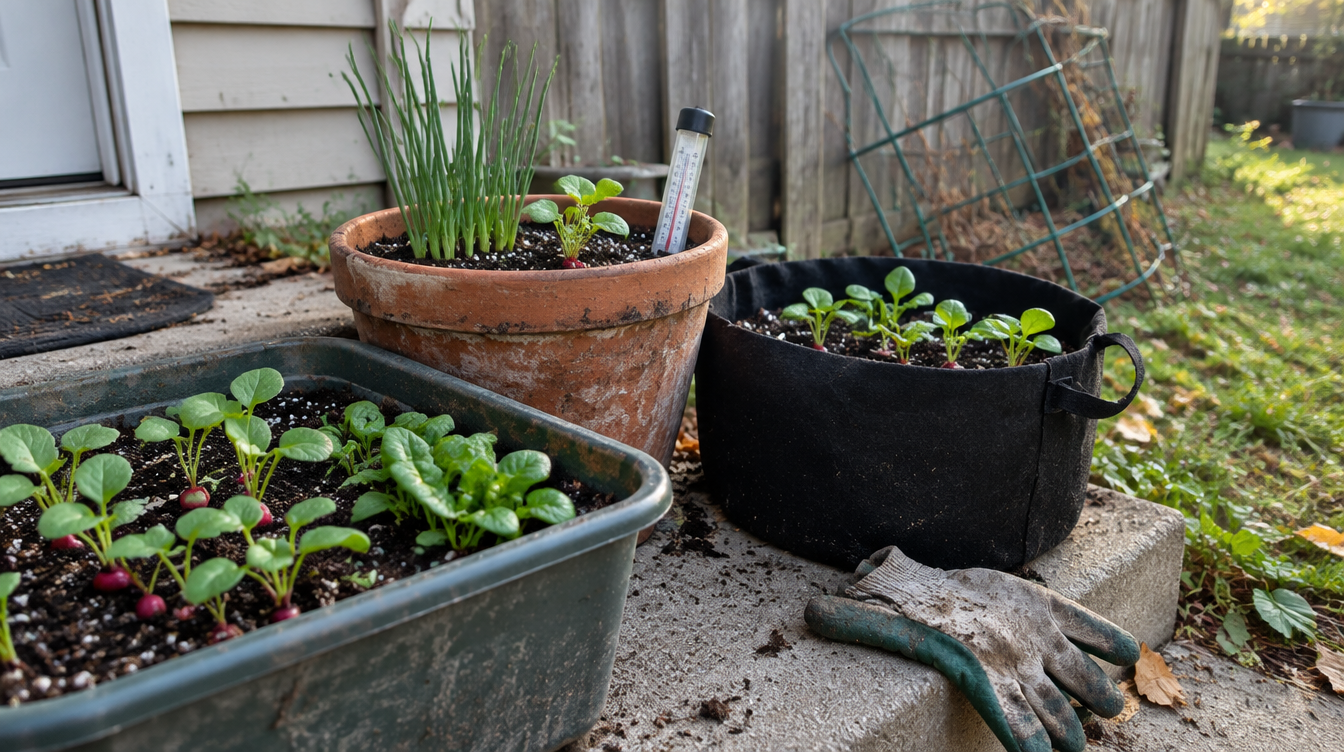
Nope. Radishes, scallions, and baby lettuce still fit a lot of yards in late September. Garlic goes in this fall too.
Your first frost date decides the rest. This guide sorts the vegetables to plant in September by how many weeks you’ve got left, so you can put 3 of them in the ground this weekend.
How Do You Know Which Vegetables to Plant in September?
Count back from your first frost date. If a crop’s days to maturity, plus about 2 weeks for slow fall growth, fit inside the days you have left, plant it.
A September date in Minnesota and a September date in Georgia are 2 different animals. Frost sets your deadline. Soil temperature decides if the seed even wakes up.
You can check both in about 10 minutes. Start with the date.
Find Your First Frost Date
Your first frost date is the average day your area first drops to freezing. Look yours up by ZIP code with the free frost date lookup at Garden.org, which pulls from NOAA data. Your county extension office can tell you too.
Write it on a sticky note and put it on the fridge.
Then give yourself a week of cushion, because it’s an average and frost shows up early some years. Low, open spots in a yard are frost pockets, so a pot on a sheltered porch gets a little more time than one out by the back fence.
Do the Frost Countdown
The math takes 1 minute.
Take the days to maturity off your seed packet. Add 14 days, which Virginia Tech Extension’s fall gardening guide calls the fall factor, because plants grow slower as days get shorter and nights cool off. Then add however long you want to keep picking.
Garden.org walks through a lettuce example, where a 45-day lettuce gets 14 days for the fall factor and 14 more for picking, so that’s 73 days, and with frost on November 1 you’d sow it around August 20.
That’s early.
So August is the real planting month for most fall crops. Next year, start then.
Already late September? Use this chart. It’s rough, and your seed packet and your extension office get the final word.
Frost-hardy crops slow down at first frost. Tender ones like beans and squash quit, which is why they’re not here.
| Weeks before first frost | What still fits |
|---|---|
| Under 4 | Scallion cuttings. Radishes, if you’ll cover the pots on cold nights. |
| 4 to 6 | Add baby lettuce and baby spinach. |
| 6 to 8 | Add claytonia and mâche, which are slow but tough. |
| 8 to 12 | Add carrots, kohlrabi, and snow peas. |
| Any time | Garlic, by your zone’s window. |
Read Soil Temperature, Not Air Temperature
You sow a pot of spinach on a warm Labor Day weekend. You water it every day. Two weeks go by, the soil’s still bare, and you figure the seed was bad.
It probably wasn’t.
A dark pot soaks up sun and holds heat long after the air cools off. Utah State University Extension says lettuce and spinach seed can go dormant when soil runs above about 80°F.
So push a probe thermometer 2 inches into the pot in the afternoon and read it.
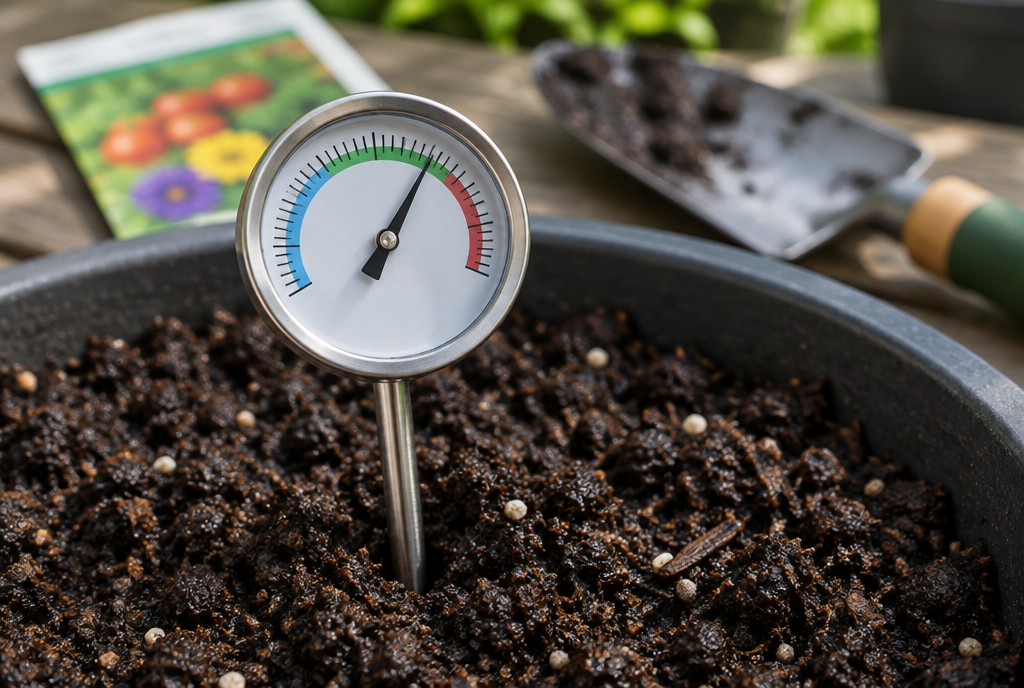
Too warm? Shade the pot. Utah State suggests sowing later in the day and watering right after.
Virginia Tech Extension shares an old trick too. Lay a board over the seeded row until the sprouts just reach the surface, then pull it off. A flat tray does the same job on a pot, as long as you peek under it every day.
Or wait a week for cooler nights. Nothing wrong with that.
STOP POINT: Don’t sow lettuce or spinach into soil above about 80°F. Shade the pot, sow in the evening, or wait. Seed sown into hot soil just sits there, and it’s easy to think you did something wrong.
CHECKPOINT: Frost date on the fridge. Weeks left counted. Soil temperature read in the pot you plan to use. Now find your row in the chart.
How Do You Get Summer Pots Ready for Fall Crops?
Pull the old plants, mix in some compost, and make sure the pot drains. Virginia Tech Extension says fall crops need the nutrients your summer crops used up, and a light layer of compost puts them back.
A tomato pot in September is mostly roots and tired mix. Seed sown straight into that gets a rough start.
It’s a 20-minute fix. It comes down to the soil, the pot size, and what the pot is made of.
Clear the Old Plants and Refresh the Soil
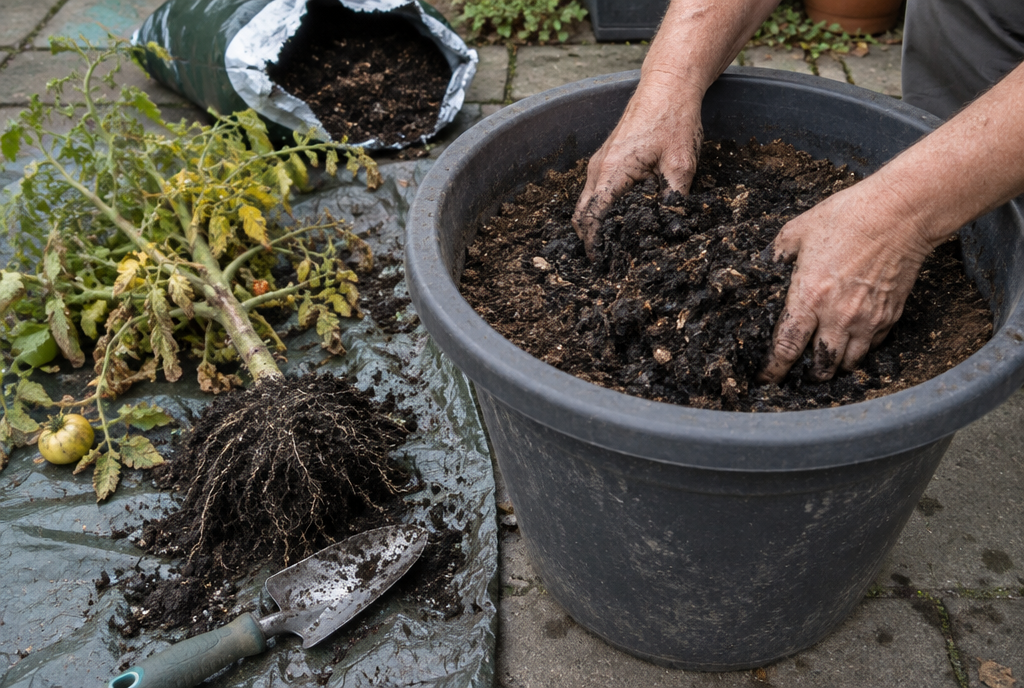
Pull the spent plants and knock the dirt off the roots. Pick out the big root balls.
If a plant had spots, wilt, or bugs, it goes in the trash. Virginia Tech Extension says to pull diseased or infested plants so the problem doesn’t carry into the next crop.
Healthy plants can go on the compost pile. (If you keep a worm bin, the soft leaves make good worm food too, and our guide to vermicomposting shows how to set one up.)
Mix a few handfuls of compost into the old mix. If it’s packed hard or mostly roots, dump it and use fresh bagged potting mix. Skip plain garden soil, since it packs down tight in a pot.
If you’re growing in a raised bed instead, our guide to no-dig garden beds shows how to feed the soil without turning it over.
Match the Pot to the Crop
Most vegetables want at least 6 to 8 inches of mix. Carrots and peas want 10 or more.
| Crop | Pot depth |
|---|---|
| Radishes, baby lettuce, spinach, scallions | 6 to 8 inches |
| Mâche | 6 inches or more, and wide |
| Claytonia | 4 inches or more, and wide |
| Carrots | 10 to 12 inches for short types, 18 for full-size |
| Kohlrabi | A 5-gallon pot holds about 4 plants |
| Snow peas | 10 inches or more, plus a trellis |
| Garlic | 10 to 12 inches, and wide |
Go bigger when you can. Ohio State’s Hannah Mathers told HGTV that any container leaves roots open to the air temperature, and a pot with more soil in it gives them more cover when the cold hits.
Check Drainage and Container Safety
Every pot needs holes in the bottom. Roots sitting in water rot, and cold weather makes it worse.
Then look at what the pot used to be. Use food-grade buckets, never ones that held paint or chemicals. If you build a box, use cedar or redwood instead of treated lumber.
Skip old painted windows, doors, and furniture made before 1978, since that paint may contain lead. When the kids help, dampen the mix to cut the dust, and everybody washes up after.
CHECKPOINT: Old plants out. Compost mixed in. Holes in the bottom. A container you’d be fine storing food in.
Which Vegetables Fit When You Have Only a Few Weeks?
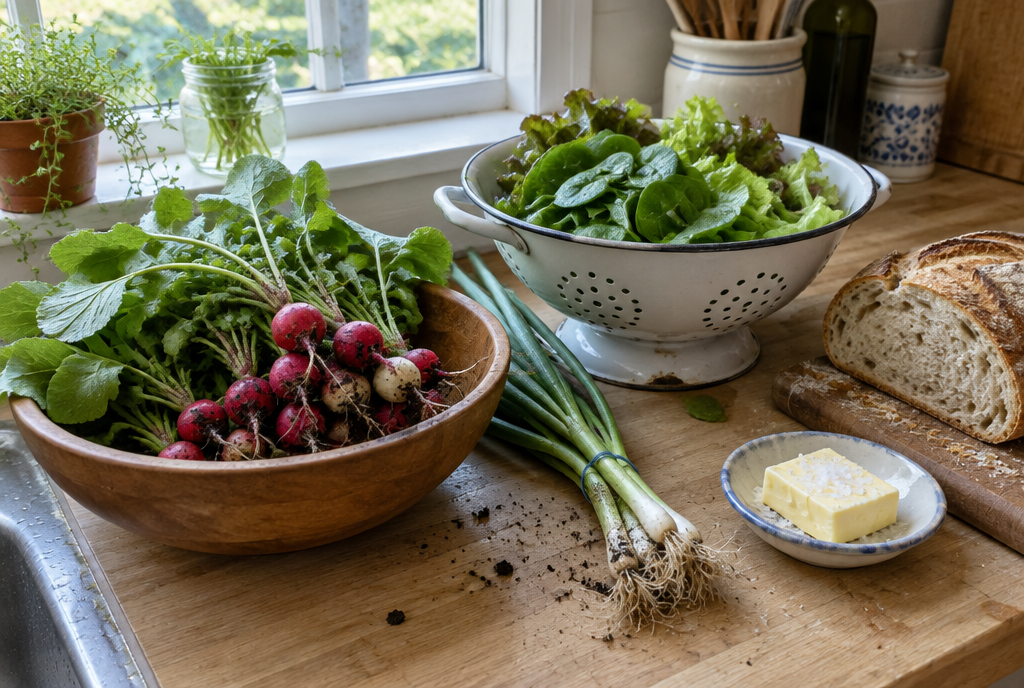
Radishes, scallions, and baby lettuce. Radishes take about 25 to 35 days, according to University of Maryland Extension, and South Dakota State University Extension says baby lettuce leaves can be ready in as few as 26 days.
These are your quick wins. You can be eating out of the pot inside a month, and that does a lot for your nerve going into winter.
Each one wants its own kind of care.
Radishes
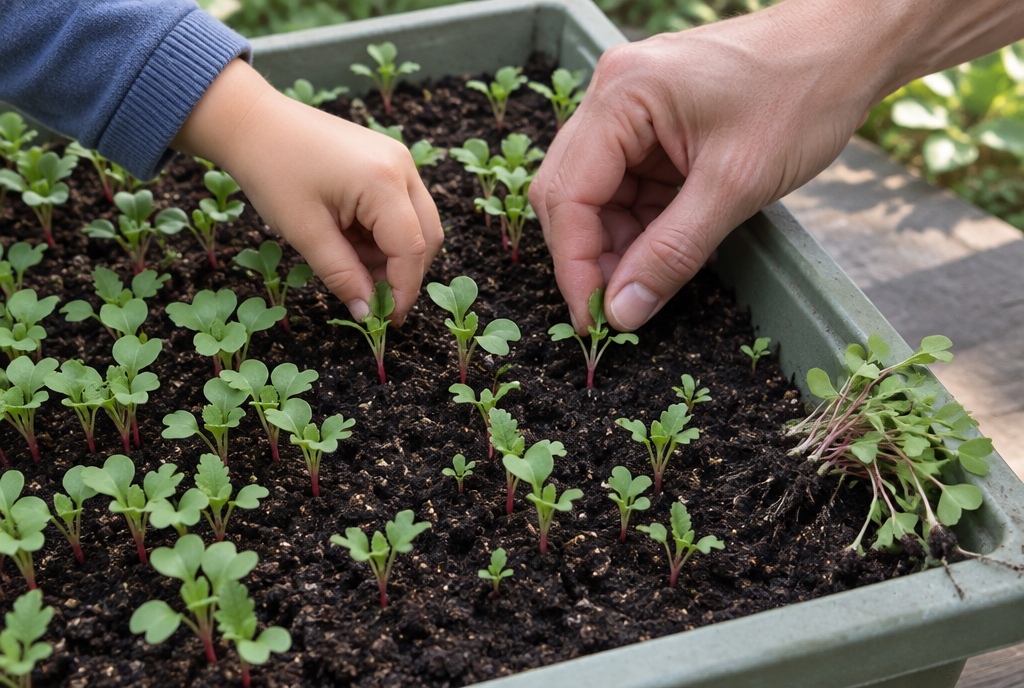
Sow seed about 1/2 inch deep. Once they’re up, thin them.
This is the step people skip. University of Illinois Extension says to thin spring radishes to 1/2 to 1 inch apart, and if you don’t, you get a pot full of leaves and no radishes.
Keep the mix evenly damp. Slow growth makes radishes hot and woody, Illinois says, so don’t let the pot dry out and then flood it.
Pull them at about an inch across. Harvest to Table says to start sowing fall radishes 4 to 6 weeks before your first frost, then add a new batch every 10 to 14 days.
First meal: Radishes with butter and salt on fresh bread.
Scallions
Save the white ends from a store-bought bunch, roots and all. Keep about 2 inches of the white part.
Poke holes about 1/2 inch deep and an inch apart. Set the ends in and water them in.
A glass of water works for a quick start. Soil grows bigger plants that last a lot longer.
Snip the green tops with clean scissors and leave the base, and it keeps sending up more. Keep the mix damp but never soggy, since a wet base rots. Cover the pot on hard-freeze nights.
Watch: saving the root ends and getting them growing again. Video by Epic Gardening.
First meal: Scrambled eggs or a pot of soup.
Baby Lettuce
Sow thick and cut young. South Dakota State suggests 4 to 6 seeds per inch in a band, covered with about 1/8 inch of soil.
Keep it damp and cool, and sow again every 2 to 3 weeks. Read the soil temperature first, since lettuce seed just sits there in hot soil.
First meal: A side salad with oil and vinegar.
Which Cold-Hardy Greens Keep Growing Into Winter?
Spinach, mâche, and claytonia. They sprout in cool soil and handle freezing nights, and Botanical Interests says its big-seeded mâche will ride out 10°F most of the time.
Eliot Coleman’s Four-Season Harvest is the classic book on eating from the garden all winter. Hardy salad greens like these are what that style of gardening runs on.
Growth slows way down in the cold. A slow leaf isn’t a dying plant, and each of these 3 has its own quirk.
Spinach
Use a pot 6 to 8 inches deep and nice and wide. Check the soil first, since spinach seed goes dormant above about 80°F. Sow it about 1/4 inch deep.
Cut the outer leaves and leave the center. The plant keeps making more.
Want spinach in March? South Dakota State says fall-sown spinach can make it through winter under straw mulch or row cover, as long as the plants are 1 to 3 inches tall before winter sets in. So get it sown early.
Watch: picking the outer leaves so the plant keeps making more. Video via YouTube.
First meal: Eggs with wilted spinach.
Mâche
Mâche is slow. Real slow.
Botanical Interests says the seed takes 10 to 20 days to sprout, in soil between 40 and 68°F. Sow it 1/4 to 1/2 inch deep and leave it where it lands, because it doesn’t like being moved.
Give it 3 weeks before you worry. If nothing’s up and the soil reads warm, the seed is waiting on cooler weather.
Cut whole rosettes at the ground, or cut 2 inches up to get another cutting later.
First meal: A plain salad with a squeeze of lemon.
Claytonia
Claytonia goes by miner’s lettuce too. Sow True Seed says it likes shade or part shade and damp, compost-rich soil. That makes it a good fit for the shady corner where your tomatoes sulked all summer.
Cover the seed very lightly, 1/4 inch at most. It sprouts in 7 to 10 days in cool soil and is ready in about 40.
Snip leaf pairs with scissors and it grows back. Fruition Seeds says a last sowing 4 to 6 weeks before frost overwinters easily, especially under row cover. Just don’t cut every growing tip at once.
First meal: Piled on a sandwich in place of lettuce.
CHECKPOINT: Seedlings thinned. Mix evenly damp. Sow dates written down.
Which Vegetables Need a Longer Runway?
Carrots, kohlrabi, and snow peas. They need roughly 8 to 12 weeks before frost, so they only fit if your first frost is still a ways off.
If yours is closer, don’t force it. Save the seed for next August and give your pots to greens instead.
If you’ve got the time, each of these has one thing that makes or breaks it.
Carrots
Pick short types like Chantenay or Nantes for pots. Short and round types do fine in 10 to 12 inches of mix, while full-size carrots want about 18.
The mix has to be loose. Hit a clump or a rock and the root forks right around it.
Seed can take 10 to 21 days to sprout, so keep the surface damp the whole time. Thin to 2 or 3 inches apart. Most short types take about 70 days.
Cool nights add crispness, Virginia Tech Extension says. But a pot freezes long before the ground does, so pull your carrots before the pot goes solid. Our guide to building root cellars covers how folks kept carrots all winter.
Watch: sowing and growing short carrots in a pot. Video via YouTube.
First meal: Roasted with olive oil, or simmered into broth.
Kohlrabi
Kohlrabi is the round, swollen stem that looks like a little green space alien. Sow seed 1/2 inch deep and thin to 6 to 8 inches apart, so a 5-gallon pot holds about 4 plants.
It takes 45 to 60 days. Pull it at 2 to 3 inches across, because the big ones turn woody.
It handles a hard freeze fine. The young leaves cook up like any other greens.
First meal: Raw sticks with salt, or a crunchy slaw.
Snow Peas
Put the trellis in on sow day. Add it later and you’re shoving stakes through the roots.
Sow seed 1 inch deep and about 2 inches apart. Run the frost countdown with your packet’s days to maturity, and if the numbers are tight, plan to cover the pots on cold nights.
Hard frost is rough on pea flowers. Pick pods while they’re still flat, before the peas inside swell.
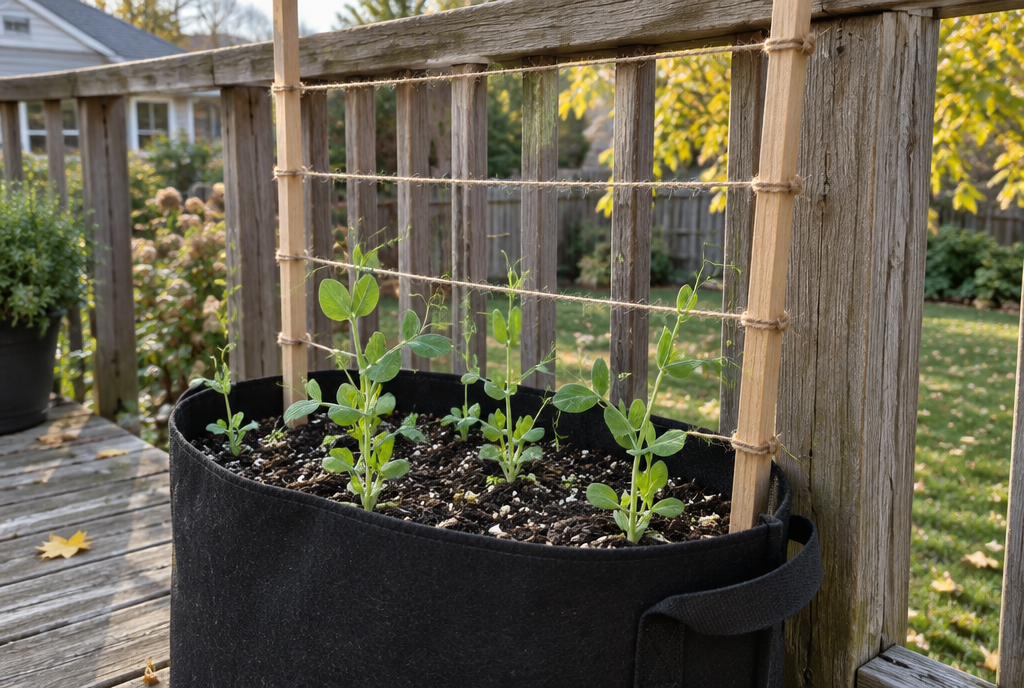
First meal: A quick stir-fry, or raw in a lunch box.
Which Vegetable Should You Plant Now for Next Summer?
Hardneck garlic. You plant cloves this fall and dig bulbs next summer.
Garlic runs on a slower clock than anything else here. Cloves put down roots in fall, sit through winter, and bulk up in spring.
A lot of folks think garlic goes in during September, and that’s only true up north. Your zone sets the month.
Find Your Garlic Window
Plant about 4 to 6 weeks before the ground freezes so the cloves can root in. Epic Gardening’s zone guide breaks it down like this.
| USDA zone | Best planting time |
|---|---|
| 0 to 4 | September |
| 5 to 7 | October |
| 8 to 9 | October to November |
| 10 to 11 | Softneck in December or January, or chilled hardneck in October or November |
Plant too early and the cloves push up green shoots that get beat up over winter, Epic Gardening notes. If you’re not sure, wait for the first chilly stretch, then plant.
Watch: picking your garlic planting window by zone. Video by Epic Gardening.
Plant Seed Garlic the Right Way
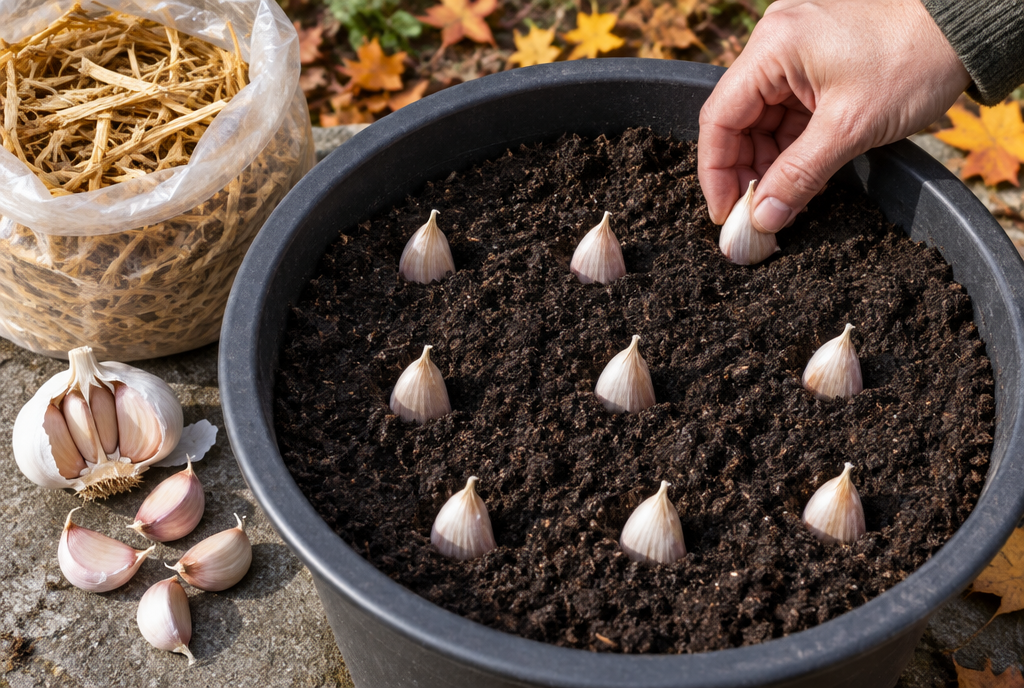
Buy seed garlic from a seed company or a local grower instead of the grocery store. Break the bulb apart right before planting and keep the papery skins on.
Set each clove pointed end up, about 2 inches deep and 6 inches apart. Use a wide pot at least 10 to 12 inches deep that drains fast, because a pot that stays soggy all winter rots cloves.
After the first hard freeze, add 3 to 4 inches of straw. Come June, hardneck garlic sends up a curly scape. Snap it off so the plant puts its energy into the bulb, and toss the scapes in a skillet.
Cure and Store the Harvest
Dig when the bottom 3 or 4 leaves have browned and the top ones are still green. In most places that’s June or July.
Wait too long and the bulbs split apart. Lift them gently, brush the dirt off, and don’t wash them.
Let them dry somewhere shady with good air before you store them. And save your biggest bulbs, because those are next fall’s seed garlic.
Which Fall Vegetables Did We Leave Off This List?
Radicchio and purple sprouting broccoli. Both are worth growing someday, but they ask a lot of a first fall in pots.
Radicchio takes weeks to head up, and plenty of folks don’t love the bitter bite. Purple sprouting broccoli grows for months before it gives you a single shoot.
Try them after a fall or two of easy wins. Right now, the pots you’re planting today need protecting.
How Do You Protect Fall Containers From Cold Nights?
Group the pots against a wall, mulch them, and cover them on frosty nights. Roots in a pot freeze long before roots in the ground, because they don’t have the earth wrapped around them.
The leaves of a hardy crop can shrug off a light frost. The roots are another story when all that’s between them and the cold is a thin plastic wall.
Start with the easy fixes and work up.
Move and Mulch the Pots
Set the pots tight together against the house. Oregon State’s Metro Master Gardeners suggest pot-to-pot in a sheltered spot, with a frost blanket thrown over the whole group.
Put them on soil instead of concrete if you can. Skip the saucers, since the water in them freezes.
Top the mix with straw or leaves. On a hard-freeze night, roll the small ones into the garage.
Add Row Cover or a Simple Cold Frame
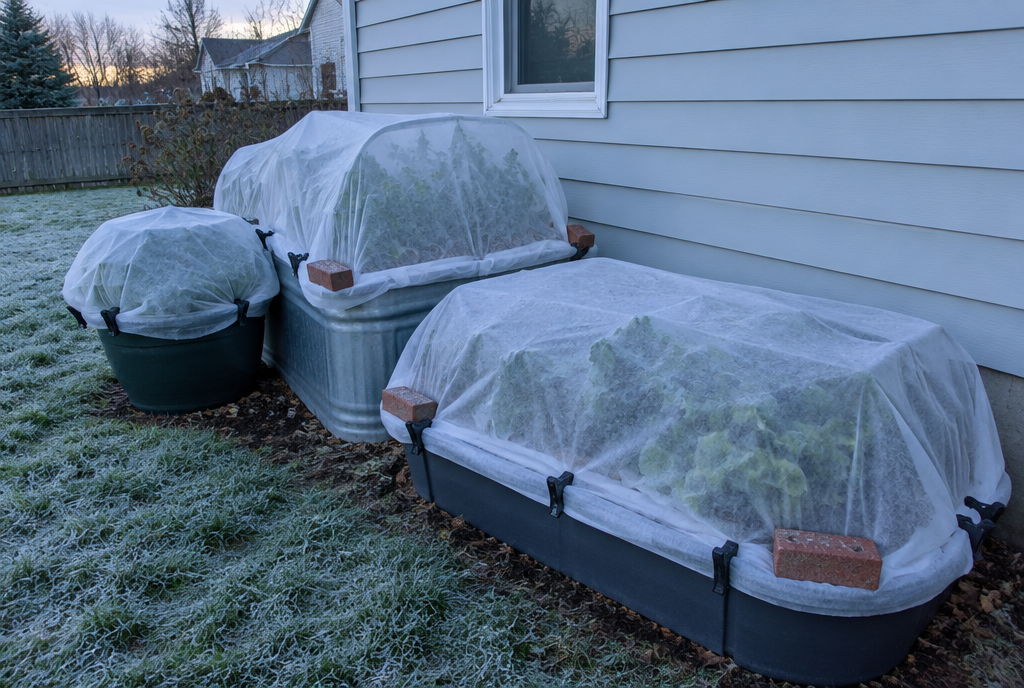
Row cover is the cheapest buy on this list. Throw it over the grouped pots on frosty nights, weigh it down with bricks or clips, and pull it back in the morning if the day warms up.
Don’t use plastic sheeting unless you prop it up. Oregon State’s Master Gardeners warn that any leaf touching the plastic in a freeze will die.
A cold frame works the same way. Virginia Tech Extension says to close the lid on frosty nights and open it once the sun warms things up. Take a glass lid off before deep winter, since snow and cold can crack it.
STOP POINT: If you build a frame from an old window, wear gloves and check the glass edges. Don’t use windows made before 1978 near food, since old paint may contain lead. Clear polycarbonate skips the glass problem.
Water Less as Nights Cool
Cool weather means pots dry slower. Push a finger in and water when the top inch feels dry.
Damp is good. Oregon State’s Master Gardeners say moist mix is less likely to freeze than dry mix, so water ahead of a cold snap.
Soggy is the problem. Waterlogged pots rot roots, so water in the morning and let the extra drain out.
What Is the Easiest Way to Start This Weekend?
Pick 3 crops, plant them in one afternoon, and check them once a week.
You don’t need all 10 crops on this list. You need a few that fit your frost date and your kitchen.
This is how to turn the list into a Saturday.
The Pick-Three Plan
Match your weeks left to a set.
- Under 6 weeks: radishes, scallions, and baby lettuce.
- 6 to 8 weeks: radishes, spinach, and claytonia or mâche under row cover.
- 8 or more weeks: radishes, scallions, and carrots or snow peas.
Add garlic when your zone’s window opens. Living under an HOA? Check the rules before row cover shows from the street.
Then plan the afternoon:
- Read the soil temperature.
- Refresh the pots with compost.
- Sow your 3 crops and label each pot.
- Water gently with a fine spray.
- Write the sow dates in your ledger.
If this is your first year at any of this, our first-year homesteading action plan maps out what comes after the pots.
Give Each Child One Job
Kids like small, quick jobs. A 6-year-old can read the thermometer, drop seeds, and water gently.
A 9-year-old can thin radishes, snip scallions with kid scissors, and press garlic cloves in pointed end up. Let your oldest wash and slice the first radish.
Everybody washes hands after handling soil.
Keep a Pot Ledger
A ledger is one page where you write down what you sowed and what happened. Note the sow date, sprout date, thin date, and first harvest, plus a line about the soil or weather.
Here’s how an example row looks.
| Pot | Crop | Sown | Sprouted | Thinned | First harvest | Note |
|---|---|---|---|---|---|---|
| A | Radishes | Sep 26 | Oct 1 | Oct 6 | Oct 24 | Soil was 72°F at sowing |
Example row. Scroll sideways on a phone.
When something fails, the ledger tells you why. Change one thing next time.
Pick One Weekly Check Day
Pick a day. Spend 10 minutes checking dampness, thinning, picking, and reading the frost forecast.
Keep the row cover by the back door. Once a week is easy to keep up, and fussing every day wears you out by October.
What Goes Wrong With Fall Containers, and How Do You Fix It?
| Symptom | Likely cause | Fix |
|---|---|---|
| No sprouts after 2 to 3 weeks | Soil too warm, mix dried out, or seed too deep | Read the soil temperature, shade the pot, keep it damp, and sow shallow |
| Lots of leaves, tiny radishes | Crowding or heat | Thin to about an inch and sow again in cooler weather |
| Hot, woody radishes | Slow growth or uneven water | Keep the mix evenly damp and pull at about 1 inch |
| Forked or stubby carrots | Packed mix or crowding | Use loose mix, thin early, and pick short types |
| Woody kohlrabi | Left too long | Pull at 2 to 3 inches across |
| Peas flower but set no pods | Frost hit the flowers | Sow earlier next year and cover on frost nights |
| Garlic cloves rot | Waterlogged pot | Improve drainage, raise the pot on feet, and water less |
| Soil frozen solid | Small pot out in the open | Move it against the house, mulch, cover, or go bigger |
The cool season is just getting going, and your pots are ready for it.
Count back from your frost date, check the soil, and pick 3 crops you’ll actually eat. That’s the whole trick with vegetables to plant in September. Write the dates down, and next August, start a couple of weeks earlier.
Once you’re picking, our easy fermented vegetable recipes are a good home for extra radishes and kohlrabi. Come spring, our guides to starting seeds indoors and when to plant a garden take it from there.
Two books worth keeping on the shelf are Eliot Coleman’s Four-Season Harvest and Mike and Nancy Bubel’s Root Cellaring.
Frequently Asked Questions
What vegetables can you plant in September?
Radishes, scallions, baby lettuce, spinach, mâche, and claytonia fit a lot of yards in September. Carrots, kohlrabi, and snow peas need about 8 to 12 weeks before frost, so they suit warmer areas. Garlic goes in this fall too, but your zone sets the month. Count back from your first frost date to sort your list.
Is it too late to start a fall garden in pots?
Not most years. Radishes and baby greens need about 4 to 6 weeks. If frost is closer than that, cover the pots on cold nights and pick small. If frost is only days away, save your seed for next August and get ready for garlic.
What vegetables should you plant in September if the soil is still hot?
Hold off on lettuce, spinach, and mâche. Lettuce and spinach seed goes dormant above about 80°F, and mâche wants soil under about 68°F. Read the soil 2 inches down with a probe. Shade the pot, sow in the evening, and keep it damp. Radishes put up with warmer soil, so start there.
Should you plant garlic in September or October?
Your zone decides. Zones 0 to 4 plant in September. Zones 5 to 7 plant in October, and zones 8 and 9 plant in October or November. Aim for 4 to 6 weeks before the ground freezes. Planting too early is the mistake to avoid, since cloves sprout and get beat up over winter.
How much does a September container garden cost?
Plan on roughly $20 to $40 if you already own pots and potting mix. Buying 3 pots, mix, and row cover may run $75 to $150. Seed packets run about $3 each. These are rough estimates, and prices vary by store and by year.
Hot-Take Poll
Opinion: Leaving your pots empty all fall is the biggest waste in gardening.
- Agree. Empty pots in fall are a wasted window.
- Disagree. Soil needs a rest, so pull the plants and quit until spring.
- Neither. Top it with compost and mulch and let it feed spring.
Defend your pick in the comments. Winning argument gets pinned.
When Should You Call a Pro?
Fall planting is low risk, and you don’t need a licensed pro for it. For local questions, call your county extension office or a master gardener helpline.
They’ll confirm your frost dates, name the bug chewing your kale, and point you to varieties that do well near you.
Hire a licensed electrician before you add a heater or lights to a cold frame, and never run cords across wet ground. Not sure a pot, a board, or an old window is safe near food? Skip it and buy a new food-safe container.
What Should You Buy Once for Fall Containers?
Buy a probe soil thermometer before anything else. It’s the cheapest way to avoid a failed sowing.
Then pick from this chart.
Best
Buy once, keep for years
- Pots: Large, thick-walled pots that hold steady soil temperatures
- Row cover: Medium-weight fabric with clips
- Trellis: Sturdy metal or cedar trellis
- Seed garlic: Seed garlic from a local grower
Where most land
Better
Solid gear, lower cost
- Pots: Fabric grow bags, 5 to 7 gallons
- Row cover: Light fabric over hoops
- Trellis: Netting or string on stakes
- Seed garlic: Seed garlic from a seed company
Budget
Start with what you have
- Pots: Food-grade buckets with drilled drainage holes
- Row cover: Light fabric weighted with bricks
- Trellis: String on an existing railing
- Seed garlic: Your own saved cloves, from next year’s harvest
